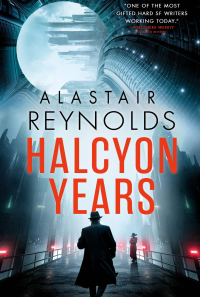
 There is a modern triumvirate of British far-future space adventure SF writers: Neal Asher, Iain M. Banks, and Alastair Reynolds. I listed them alphabetically, but that also happens to be my order of preference for their work. Make no mistake, I like all three, but I have found myself disengaged by a few of Reynolds’s books.
We started on a positive note [see this post], but I quickly ran into some issues with his writing [see this post and this post]. I was very disappointed by a couple of his books. That so far hasn’t happened with Banks or Asher.
Recently, though, I read Reynolds’s Halcyon Years (2025).
I devoured it in three days and really enjoyed it. It’s essentially a Private Detective novel with all the trappings of the genre, but Reynolds has spun an extremely inventive version.
For one thing, the PI in this story is one Yuri Alekseyevich Gagarin. Yes, that one, the Russian cosmonaut. He’s a PI on a generation ship many hundreds of years in the future. The ship is headed for “Vanderdecken’s star” — a 400-year journey. When the story stars, it is year 355 of the trip with 45 years remaining (“55 tops”).
Yuri is a “Jack” (as in “Jack in the Box”) — someone brought along in cold storage and revived to add newness and interest to life on the ship. His accent and grammar, which are strongly Russian, make him stand out as a Jack (he is treated by many as a second-class citizen).
The first chapter begins like many other PI stories: in a seedy bar where Yuri hopes to take photographs of a cheating spouse. It doesn’t go well, and we learn that Yuri — like so many fictional PIs — can be a bit down on his luck and hapless. We also see the traditional PI courage, though.
We’re not treated to exactly who he is at first (unless you’re a fan of space exploration and put the first name Yuri together with “Gagarin Investigations”). Once it becomes clear, we discover that one of Yuri’s small regrets is that no one remembers who he is. He hardly seems a source of newness and interest.
This puts the reader in a conundrum. What the heck is Yuri Gagarin (1934-1968) doing on a generation spaceship many hundreds of years in the future? Didn’t he die in a terrible airplane crash a year before we walked on the Moon?
Yes. Yes, he did. But don’t think for a minute that I’m going to explain it here. This story has too many delightful mysteries for me to spoil any of them. Suffice to say that, as with any self-respecting PI story (and many SF stories), there is more — much more — going on than there appears to be.
§
The ship, the Halcyon, is 50 kilometers long, hollow with a “skytube” running down the center for light (and apparently rain). The ship uses the rotating cylinder design to provide gravity on the inner surface of the cylinder. Both ends taper, providing lower-gravity regions for hospitals, wealthy residences, and entertainment facilities.
Two wealthy families control life on Halcyon, The Urry’s and the DelRosso’s.
Yuri is visited in his canonically seedy office by a canonically attractive women calling herself Ruby Blue. She tells him that a daughter of the DelRosso family, Juliana, died recently from injuries sustained in an unknown incident outside the ship. Several weeks later, a son of the Urry family, Randall, died from a misadventure involving an energy weapon. Randall was presented as an “accident waiting to happen”.
Ruby Blue, representing the ships Department of Works, wants Yuri to investigate these deaths. Juliana and Randall were known to be romantically involved, and supposedly both were outside when the incident that injured Juliana occurred.
Most fictional PIs, when working on what turns out to be a Significant Case, are soon visited by someone who wants to interfere with or stop their investigation. Often for very plausible reasons. Yuri is soon visited by Ruby Red — Ruby Blue’s sister.
Throw a dart in any mystery library, and you’ll probably hit a book with a plot that starts very much like this one. (But not likely on a generation ship where the PI is Russia’s most famous cosmonaut.)
§
Things proceed as any reader of the genre expects. Yuri slowly, sometimes painfully, uncovers clue after clue — many of them not making much sense.
Ruby Blue provides him with a Department of Works identity card that gives him access to almost anywhere he wants to go, including visiting and interviewing the Urry family and DelRosso family. Who both appear to be cooperative but also disdainful of this “little man” and his investigation.
Eventually, Yuri begins to uncover the truth, including what’s really outside the ship and … well, a number of other closely protected secrets that change the story in big ways. As I said, I won’t spoil a bit of it. Suffice to say that there’s a Big Lie to be uncovered, and it goes All the Way to the Top. (Isn’t there always, and doesn’t it always?)
I will mention that Ruby Blue also provides Yuri with a nice new car and a robot partner. There aren’t many robots left because their “neuromimetic” cores began to degrade after hundreds of years into the journey. Yuri receives one that has been in storage for a long time.
The robot, which Yuri names Sputnik, acts as a mildly comic sidekick. After years of storage, its memory circuits need repair (which it can accomplish itself given time), so it suffers from robotic Alzheimer’s — it forgets information, often information it has just been given.
[In an astronomical context, “sputnik” is Russian for “satellite” but in other contexts means “spouse” or “traveling companion”.]
§
I claim no authority on Reynolds’s work, nor Asher’s, nor Bank’s, but this one seemed a bit different from the kind of books all three authors usually give us. For one thing, it’s noticeably shorter. The e-book I read weighs in at 766 pages, whereas most of their books go over 1,000.
Different also is that the narrative stays with Yuri throughout the story (third person omniscient with transparent narrative). So, there is just one plot thread in contrast to the multiple threads these authors typically use.
In fact, one of my minor complaints about all three is the way their narratives jump around from thread to thread — often without warning or anything typographical to indicate the shift. (That may be an e-book thing. Maybe printed books have a double-space that gets lost when translated to e-book?) Generally, there is a character name in the first paragraph to clue you, but it’s sometimes possible to read two or three paragraphs of description before realizing you’ve jumped threads. There is often a large cast of characters to keep track of.
I have found that, with Asher especially, there seems to be a quip-like line or startling observation or thought that ends the scene. Often, I find myself thinking, yep, bet that’s the end of the scene. It’s a very cinematic editing, though I find it a bit too choppy sometimes.
Part of the attraction with all three authors is the sheer scope of the stories — literally galaxy-spanning, often with high stakes involved. Danger to all humanity kind of stuff. Which is great, often fascinating and hugely inventive, but the scale is so beyond my life experience that it has a fantastical aura. I find myself much more engaged by smaller stories with smaller casts and smaller stakes. Stories with a better impedance match to my life and experiences.
One other minor irritation about their writing — and off the top of my head I think Reynolds might be the biggest offender here — is the tendency for one character to say something, then several pages of either third-person description or first-person rumination, and after these several pages, another character finally replies. It drives me a little crazy because I never remember what the first person said, so I have to page back and remind myself.
Please, put the digression where it doesn’t interrupt the flow of dialog. I just don’t understand the tactic. Longer scenes and longer stretches of uninterrupted dialog would make me happier with their books. (To be honest, I could do with less description, too, but that could just personal taste.)
This book delighted me with all that. Reynolds seems to be deliberately channeling the canonical private eye style here (and I loved it). Things are tighter, less descriptive, less digressive. That said, I was sometimes a bit borderline on whether he was giving a loving homage or aping all the usual PI beats. Regardless, I loved it and will call it an homage.
[Therefore, it cracked me up when, in the last part of the last chapter when, halfway down page 762 Yuri asks, “If you agree?”, and then, halfway down page 765 (three pages later), another character replies. I had to page back to remember what the question was.]
§
As I said, I devoured this in three days — three sittings. It was hard to put down. I give this a strong Ah! rating. It comes very close to a Wow! rating. That said, full disclosure, I’m a sucker for a good PI story, so I may be a bit biased.
I’ve been reading SF as long as I’ve been picking my own reading material, but my interest in murder mysteries and private detective stories starts later (and is largely inherited from my dad). First was Sherlock Holmes in grade school. In high school, various other authors, often on recommendations from my dad.
I’ve long thought science fiction isn’t a genre but a platform — one that supports every fiction genre: adventure, exploration and journeys, romance, comedy, slapstick, pathos, private detectives, police procedurals, intellectual exercises, poetry, and anything else some SF author has come up with.
Plus, science fiction has its own wrinkles that add a dimension: generation ships, robots, genetic manipulation, time travel, alien life, and — once again — anything else some SF author has come up with. (It’s this added dimension that makes mundane fiction pale for me. Science fiction has everything ordinary fiction has plus the extra trappings of SF.)
§
In closing, two recommendations.
Firstly, if you read Halcyon Years, pay attention to the Russian word “Poyekhali!” and its context — you’ll be glad you did. It resulted in a big grin at the perfect moment for me.
Secondly, if you like science fiction private detective stories, I can recommend Red Planet Blues (2014) by Robert J. Sawyer (not just a modern hard SF author but a contemporary one — I’m a big fan and have posted about him before).
Stay detecting, my friends! Go forth and spread beauty and light.
∇






 Logos con carne
January 31st, 2026 at 12:12 pm
I just started reading it after finishing Iain Banks’ Excession. (Which I should have a post out on soon.) I’m finding the writing a welcome change from Banks, but that might be due to Reynolds channeling the detective style.
I’m completely with you on the thing where in the middle of a conversation, the author goes into a multipage aside. Even if relevant, there has to be a better way. Banks does it in Excession, and it drives me nuts. Not looking forward to it in this book.
I immediately caught the Yuri Gagarin thing, initially wondering if Reynolds was just doing an Easter egg, but then the woman sees the picture and he says he was a cosmonaut. Now I’m looking forward to learning how that situation exists, with alt-history, simulation, and secret-history possibilities running through my head.
The book has 329 pages in the Kindle edition, which is short for Reynolds, although that was more than enough for the old detective stories. Hopefully some of that style will permeate to his other stuff. For some reason, I feel the wordiness less with Reynolds than with Banks or Asher, although at times he can be just as bad.
January 31st, 2026 at 2:44 pm
> “… with alt-history, simulation, and secret-history possibilities running through my head.”
🤐😁
The book length on my library app’s e-reader is very much like the Patricia Wentworth murder mysteries I’ve been reading lately. Or really any “normal” length novel.
Now I have to decide whether to wait for the hold I have on Asher’s Brass Man (I’m next in line, so it could happen any day or not for a week or more) or read another Wentworth mystery as a palette cleanser.
I was really surprised Halcyon Years became available so soon. I was expecting several weeks wait. It’s almost as if many of those ahead of me in line bowed out for some reason. Or maybe people read it really fast. 🤷🏼♂️
January 31st, 2026 at 3:47 pm
Do you have any time limit when the book becomes available? Does it just get delivered to you or do you have to do anything?
When I saw your post, I wondered if you’d just decided to buy Halcyon Years. Maybe this time it was your library that got the copy and it was your turn to get priority. The system does seem somewhat unpredictable.
January 31st, 2026 at 6:03 pm
The app notifies when it’s your turn. You have the option of declining, getting back in line, or checking out the book. (All book checkouts are for 21 days, though you can renew on the last day if no one else is waiting.) I’ve never ignored the notification, so I don’t know what the response is. There must be a window. I can’t imagine it would leave the book in limbo for very long. (I’ll see if I notice any fine print about it next time a book becomes available.)
I wondered if perhaps it was others who decided to just buy the book, and that’s why they bowed out of the queue. The system definitely is unpredictable.
January 31st, 2026 at 9:47 pm
This book sounds fabulous, and I’m going to look for it. Science fiction is not my usual type of read, but the premise sounds fun and imaginative—always my cup of tea, no matter what the genre!
February 1st, 2026 at 9:26 am
I sure enjoyed it, and thinking about it, it’s probably pretty accessible to all readers. Some SF demands some science background or just experienced with SF troupes, but I think this one would work for anyone. It’s more of a PI story than a murder mystery, but the latter is part of it, too. I’ll bet you enjoy it! (Come back and let me know what you thought if you do read it.)
February 2nd, 2026 at 5:28 am
Will do!
February 8th, 2026 at 5:02 am
Iain M. Banks is my favorite too, but I’ve been meaning to dive deeper into Alastair Reynolds’ work – what specifically disengaged you from some of his books? 🤔
February 8th, 2026 at 11:33 am
We started off on a high note, but see this post (about halfway down) and also this post a month later. Those posts pretty well sum up the problems I had with Reynolds’s writing style.