 About a month after I started this blog (on July 4, 2011), I wrote about my first and second skydives — which were tandem jumps — as well as my first (semi) solo skydive. A year later, I wrote about graduating my training to a full-fledged solo jumper as well as a particularly enjoyable skydiving “boogie”.
My last jump was in September of 1999 when the owners of the drop zone suggested that — because I wasn’t putting in the time needed to improve — that it might be best if I considered another hobby. They were right, and I did.
At that point I had made 50 jumps in two years. Here is my logbook.
In what follows, the bold lines specify jump number, date, location, type of airplane, exit altitude, and type of jump. (Note: The location “Hutch” is Skydive Hutchinson in Hutchinson, MN. It closed some years ago.) The text after is whatever notes I made about the jump. In italics following the entry are added notes while transcribing.
#1. 1997-08-09: Hutch; C-206; 10,000; Tandem Jump
Skydiving? Hell yes!!!
My new girlfriend, CN, had planned a skydive with her gal-pals, and I invited myself along because it was something I’d wanted to try for a long time. [For details, see My First Skydive!]
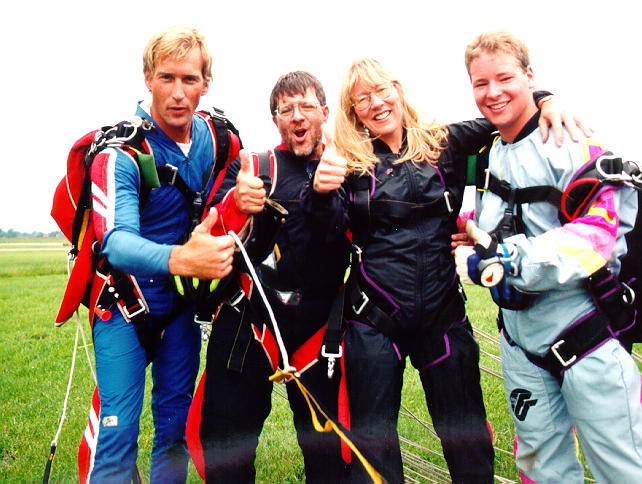
A great first skydiving experience!!
#2. 1997-08-16: Hutch; C-206; 10,000; Tandem Jump
Two jumps … One Cutaway!! Way too much fun!
We enjoyed the first jump so much that we returned a week later to do it again. We had so much fun the second time that we decided to become skydivers. [For details, see My Second Skydive!]
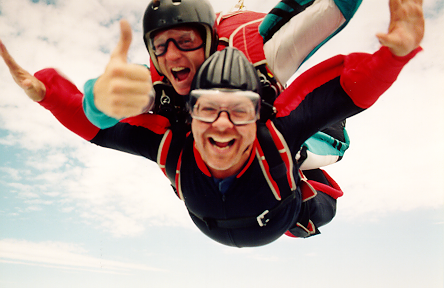
A really fun freefall and deployment followed by a cutaway!
#3. 1997-08-27: Baldwin; Beaver; 12,000; Tandem Jump
(no notes)
I was so hooked I drove out to Skydive Twin Cities in Baldwin, WI, for another chance to “get my knees in the breeze”. What was cool about the jump was that the Tandem Master let me pull the ripcord.
#4. 1997-09-06: Hutch; C-206; 12,000; AFF Training
Good climbout & exit. Legs out on first wide — responded. 3 good PRCPs. Legs out on 2nd wide — had brought them in during PRCPs. Good alt awareness & punch at 5,500. Cleared for level II — nice skydive! (Doesn’t need much radio help.)
My first (semi) solo skydive. Two instructors jumped with me; the notes are from one of them. A “PRCP” is a Practice Rip Cord Pull — they demonstrate awareness. The radio allows the ground to help you land because once you “punch” (deploy your chute) you’re on your own. [For details, see My First AFF Skydive!]

I love how this photo captures the chute deployment!
#5. 1997-09-14: Hutch; c-206; 12,000; AFF Training
Good climbout & exit. COA good. Good R turn 180°. Alt check @ 9,000. Good forward motion. Done by 8,000. 5,500 on time & pull. Stay up wind under canopy. Clear to Level III.
All notes during AFF training come from one of the jumpmasters that jumped with me. At first there were two, one on either side, but later in training there was only one (just in case the student loses control). COA is “Circle of Awareness”.
#6. 1997-10-1: Hutch; C-206; 12,000; AFF Training
Good climbout & exit. Checked with MJM about 11,500, JM gave legs out & check arms. Good response w/ legs, ok response w/ arms. Started potato chipping after release, then brought legs in. JM gave legs out, legs came out too far (almost straight), became very flat. JMs docked, altimeter flipped under arm, could not see alt. Missed 5,500, pulled at 4,000 or slightly below. Next jump Level III. Good canopy control
I failed that jump, and it was perhaps an early indication that I wasn’t quite getting it. In truth, I never fully did, which is part of why they ultimately suggested I wasn’t cut out to be fulltime skydiver. “Potato chipping” should be obvious.
#7. 1997-10-1: Hutch; C-182; 12,000; AFF Training
Good climbout & count & exit. COA you took a while you were “thinking”. Good job & nice response to hips down & legs out & relax. JM release you were potato chipping a little not too bad. 5,500 on time & pull. Good job. Clear to Level IV. Work on relaxing a little. Great C.C.
“JM release” is when the jumpmaster lets go of you. “C.C.” is canopy control. I never really did learn to relax enough. But at least I passed the jump this time (this was on the same day as the failed jump above).
#8. 1997-10-1: Hutch C-182; 12,000; AFF Training
Good climbout & count & exit. COA good response to relax. You gave the Ok. JM release. You did an uncontrolled R turn then stopped it then it started again. You made a few revolutions. JM redocked, gave hips down & relax. Re-release @ 7,000. We just fell straight down until 5,000 & pull. Let’s do it again. Work on heading control before starting turns. Too much turning prior to landing. No more turns below 500 ft, just minor corrections.
Each level in AFF training has specific tasks to do during the jump. As I read these now, it’s becoming apparent I was starting to feel a bit overwhelmed. It was a little heartbreaking that I never got good, let alone mastered, skydiving. I so wanted to.
#9. 1997-12-20: Las Vegas; King Air A90; 12,500; AFF Training
Good exit and got stable, circle @ 11,000. JM signaled PRCP — did two okay. JM got in front, signaled “legs out” with tongue — I forgot that signal — didn’t do it — tried right turn — supposed to be 90° — did 720° — JM had to stop — need to work on turns — poor leg position, head was down, arms wrong — 6,000 no more turns — very stable down to 4,000 — wave-off & pull — okay landing.
Obviously, I filled out the logbook myself on this jump. The GF and I were on vacation in Las Vegas and decided to visit the drop zone there.
#10. 1997-12-20: Las Vegas; King Air A90; 12,500; AFF Training
Better turns. More in control, exit hard arch okay & in canopy control. Off radios, good body position.
But I landed in the desert way off the drop zone, and they had to send a vehicle out to get me. The driver got a flat tire from some tough shrub he drove over (impossible to avoid). I felt so bad. I also recall that one of the lenses in my glasses fell out and had to be duct-taped in before I could jump. Both jumps were embarrassing.
#11. 1998-04-11: Hutch; C-182; 12,000; AFF Training
Excellent spot. Exited horizontally, just clearing step. Present self 45° to horizon to hit relative wind well. Watch the plane go away. Good body position. Ok COA. A bit stiff on 90° left. Lots of correction of heading on forward motion. Finally got there. Repting [sic] on thighs with head high in neutral position. Good response to legs out eventually. Missed signal on 1st forward motion. Excellent 360°. No altitude awareness. No response to wave-off. Pulled after 2nd pull signal. Altitude awareness is the number one priority. Okay for level V. Good canopy control. Start landing flight pattern earlier. Set up final approach steeper on a windy day. Flare 1ft higher. Keep feet under you on landing.
Spotting is determining when to exit the aircraft. I was better once I was under a canopy, but I never did learn to relax during freefall. Reading the above, I’m surprised they cleared me to Level V.
#12. 1998-04-11: Hutch; C-206; 12,000; AFF Training
Good exit. You can be even more head high. Good 90°. Legs came up as getting into position for 360° right. Did uncontrolled 360° left. Arms extending & feet in burble. It’s hard to turn with arms when legs are lower. Good response to legs out but look to JM for more signals. Turns left & right as starting to try & come forward. Lost alt awareness again. Wave-off & pull a little low. Trim yourself move head down through squaring arms, extending legs & lifting thighs. More important than body compensation is changing what you expect to see. Let feet be high point of body. good canopy control. Flared a bit high but compensated well. Sat down. Repeat Level V.
Sometimes I think I was lucky to survive my attempt to learn skydiving.
#13. 1998-04-18: Hutch; C-182; 12,500; AFF Training
No chance to spot. Good count. Head high (as planned) for ½ sec. then rotated head down. Arched well to stable. Good body position but very stiff. Overturned on 90° left. Eventually got facing JM. Ok forward motion but washing vigorously. Good 360° right. Paused at 180°. No time for more. At top of dive very little shoulder bank to initiate turn. Go for it! Try the same plan again. RELAX! Good canopy control When higher, face into wind to judge glide. Move the whole pattern up 100ft. Keep feet under you. Flare faster.
Not being able to relax in stressful situations has always been a nemesis for me.
#14. 1998-04-18: Hutch; C-182; 12,000; AFF Training
Excellent exit. (No chance to spot.) Again, didn’t stop 90° left. Paused at 180° then continued around. Ok forward motion to dock. Good alt checks. Excellent 360° right & redock. Good wave-off & pull but backsliding. Maintain that good body position. Ok for Level VI. Good canopy control. Knowing it’s a light wind day, set up further back. Do hard S-turns on final approach if you give yourself enough time & are short. Ok flare but 6ft high. You could speed it up a little bit. Get feet together.
The trick of accurate landing is one of many things I never mastered.
#15. 1998-04-18: Hutch; C-206; 10,500; AFF Training
Good spot with corrections to pilot. Let wings level some to be sure where you’re going (one correction too many). Perfect exit & arch. Nice heading correction. JM demoed backloop. Two perfect BLs with good alt checks between. Good turn to designated heading. Some turning as tracking. Corrected well. Ok for Level VII. Good flare, wave-off & pull. Very nice canopy control. Overshot slightly. Remember to keep those feet together. Perfect flare. Don’t reach with legs. Nice standup.
BL for backloop, an acrobatic trick while in freefall. Landing while standing up was another difficult trick, but I got it right sometimes.
#16. 1998-04-18: Hutch; C-206; 12,500; AFF Training
Good spot. Crouched low on bombout & got feet off too early. Good arch; rotated head high. Nice turns although 1st a bit short. Lots and lots of corrections. Very spread & stiff. BL twisted into barrel roll. Good turn to track. Not much time. Practice track next time. Nice wave-off & pull. Ok for self-supervision. Good accuracy.
Stamped: (my name) has completed all requirements of the accelerated free fall program at Skydive Hutchinson. Date: 4/18/98
I’m a little amazed they passed me. Perhaps they shouldn’t have, but I did manage a lot more solo skydives without killing myself, so I guess that’s a kind of success. [For details, see AFF Graduation!]
#17. 1998-04-28: Hutch; C-182; 10,000; Solo Training
Turns good, exit bad. Flare too high.
I don’t recall if a jumpmaster jumped with me or was just aware of the jump. I think one was at least in the plane. I’ll mention here that C-182 and C-206 refers to Cessna aircraft.
#18. 1998-04-28: Hutch; C-182; 10,000; Solo Training
Need to work on exits! (& flare)
The handwriting looks like mine, so I think I was jumping solo at this point, but with some kind of oversight from a jumpmaster.
#19. 1998-05-25: Hutch; C-206; 10,000; Solo Training
Decent exit — ready for C&P?? Much faster ground speed — need longer final!!
Definitely my handwriting. I do not remember what C&P stood for. (Is it supposed to be H&P? See next entry.) Still having trouble with good landings.
#20. 1998-05-25: Hutch; C-206; 5,000; Low Altitude Jump
Hop & Pop … passed!
A hop & pop is a jump where you immediately deploy your chute without waiting for terminal velocity. Usually at low altitude (this jump was at 5,000′.) That makes the deployment mushy and strange. But it’s a necessary skill in case we need to exit the airplane early due to a problem.
#21. 1998-05-26: Hutch; C-182; 12,000; Solo Training
The backloop were not a fluke!
Bad grammar aside, apparently this jump involved the acrobatics of backloops — flipping yourself backwards to do a 360° revolution feet-over-head.
#22. 1998-05-26: Hutch; C-182; 12,000; Solo Training
Bombout exit … neat!
A bombout exit is jumping out of the aircraft like Superman (or Superwoman). Normally, you try to exit the aircraft head up and body facing into the wind (the direction the aircraft is going). The thing about a bombout is getting that stable body position which comes more naturally with the normal exit.
#23. 1998-05-26: Hutch; C-182; 10,000; Solo Training
Good exit, legs out 6″, keep body straight on turns, first try side sliding okay, good fwd motion, nice right (lost it on left), work on tracking away.
First perfect landing!
Some slow improvements, but so, so slow. And ultimately not enough.
#24. 1998-05-26: Hutch; C-182; 10,000; Solo Training
Good exit, need legs out, fly in for light grip, “fly your own slot”, fingertip grips, don’t reach, rushed turn — smooth, need to flare out of track, but good track. Accurate landing.
This jump involved docking with a jumpmaster, which I did worse than the log entry suggests. I never did get good enough to jump with a group. This is the last entry in my student logbook. After this, they gave me (or I bought?) a real skydiver’s logbook.
#25. 1998-06-07: Hutch; C-206; 10,000; Solo Jump
Solo jump — worked on tracking & did pretty well! Went on back on bombout exit (more arms?). Flare higher next time.
Flaring on landing involves pulling down on both steering toggles (lines) to essentially stall the chute. When done right, it brings you to a dead stop just as you touch the ground. Done too high, you can fall the remaining distance (and very possibly break something; like your back). Done too low, you’re moving too fast as you hit the ground. (Your forward motion under canopy is about 22 MPH.)
#26. 1998-06-07: Hutch; C-206; 10,000; Group Jump
4-way #1!!
Good exit. Excellent awareness. Backsliding when in box man. Work on keeping legs out a little more. Good track. Fun. 4 points almost 5.
The first line is my handwriting, the notes below it aren’t. This was the first time I jumped with four other skydivers and had to get into a formation with them.

Me and MOTL, off into the wild blue yonder.
#27. 1998-06-23: Hutch; C-182; 10,000; Group Jump
2nd 4-way // 1st kiss pass!!
Not a bad dive — w/ John, Rose, … and CN! some level control problems, but good exit. Stood the landing!
Rose was one of the drop zone owners; John was an expert skydiver. CN was at that point my fiancée. We got married the next month on July 4th (and watched the fireworks after the ceremony). A “kiss pass” is getting close enough to another skydiver to kiss them.
#28. 1998-07-18: Hutch; C-182; 10,000; Two-way Jump
2-way w/ MOTL!
First 2-way w/ CN!! 4 backflip exit — too cool. Separated, tried to dock but didn’t come close. Getting good w/ fall rate.
A two-way jump for the newlyweds. MOTL=My One True Love (or so I thought). She called me LOML (Love of My Life). We exited holding on to each other and did the backflips together. Oh, those were the days. (Fall rate is adjusting your downward speed to match another skydiver’s.)
#29. 1998-07-18: Hutch; C-206; 10,000; Two-way Jump
2-way w/ MMW
Same quad backflip exit — still too cool! Held on this time & stayed docked thru dive. 2 kisses.
No idea what MMW means. The W is probably for wife, but MM?
#30. 1998-08-09: Hutch; C-182; 10,000; Two-way Jump
Chasing the wife.
CN poised exit, I bomb out after, try to catch. Not even close. Got down to her level, but she was tracking away. Next time, don’t wait one sec to follow. Bif landing — flare lower!
The subtitles in these entries are from the “Maneuver” field of the logbook.
#31. 1998-08-09: Hutch; C-206; 10,000; Solo Jump
Back flips (5) off step. 2 barrel rolls. First jump in shorts & tee shirt! Adequate landing. (Video by J.)
What you wear can affect your fall rate. Fuzzy fabrics slow you down. Skin is usually fast (unless you’re very hairy). I don’t know what the video refers to. It’s nothing I remember or ever got my hands on.
#32. 1998-09-02: Hutch; C-182; 10,000; Two-way Jump
2-way w/ MOTL
CN’s first crotch exit — we f**ked it up! First funnel (beer). Split up & finished separate.
This entry almost sounds naughty. A “crotch exit” is when you climb out onto the strut bracing the wing and crouch there. When the other jumper exits the door, the jumper in the crotch jumps, too, so they’re together right away. They can even be holding on to each other during the exit. A “funnel” is when you’re holding on to each other and not catching any air — just spiraling rapidly down. (And first in skydiving, you’re supposed to buy beer.)
#33. 1998-09-29; Hutch; C-206; 10,500; Two-way Jump
2-way w/ MOTL
2 back flips on exit. Worked on fall rate. 1st jump w/ jumpsuit!
Still trying to learn to jump with another jumper. The jumpsuit is the one I bought to go with the parachute rig I also bought.
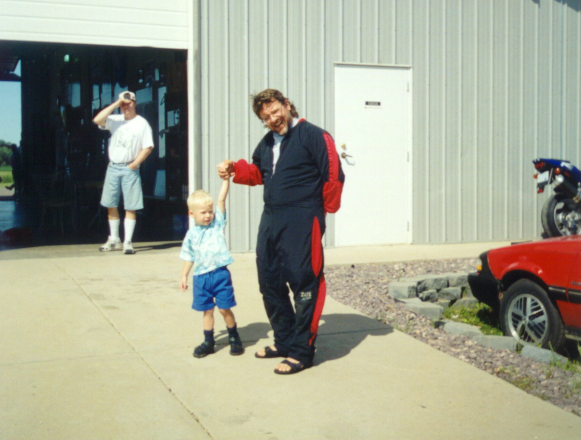
Me in my new jumpsuit (with my new stepson).
#34. 1998-09-29; Hutch; C-206; 10,000; Solo Jump
Solo w/ My Rig!!
Love that Canopy!!
First time jumping the new parachute rig (a PD210). Wish I had a picture. I’d learned to scuba dive earlier that year — so CN and I could go scuba diving on our honeymoon cruise — and my chute was designed with a “divers below” warning flag in mind. Mostly red with black stripes on the sides and a white stripe down the middle.

Color scheme of my canopy.
1999-04-29; Hutch; Retraining
“Wyrd Smythe” has been retrained at Skydive Hutchinson 4/29/99 and is ready for an AFF Level IV.
Note the time between this entry in the logbook and the previous jump. Skydivers need to keep current. If they go beyond a certain period (six months?), they have to have some retraining.
#35. 1999-07-23; Hutch; C-182; 12,000; AFF Level 4 Retrain
Friday.
Horizontal exit. Present chest to relative wind. Narrow legs & straighten them some. Good turns & redocks. Good waveoff & pull. Okay for self supervision. Okay spot but gave correction early. Good canopy control. Don’t fold up landing gear.
A “spot” is telling the pilot where you want to jump. You need a sense of the wind and altitude to figure it out.
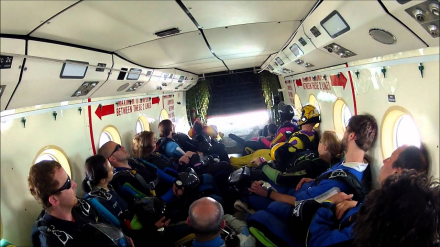
From inside a CASA rigged for skydiving.
#36. 1999-07-23; Hutch; CASA; 13,000; CASA Boogie!
Divin’ out the back of the CASA! Worked on turns. Wave off @ 4,5, dump @4.
Stood landing.
Before you deploy your chute, you “wave off” — literally wave your arms as a warning. “Dump” = deploy chute. Once you get past training — and in many places not even in training — you don’t “pull a ripcord”. You have a small pilot chute (about 18″ in diameter) tucked into an elastic pouch at the bottom of your rig (on your back). A hacky-sack or other object is attached to the top-center of the pilot chute and protrudes from the pouch. To deploy, you reach back and grab that object, yank out the pilot chute, and “throw it into the wind” as far as possible to your side.
The pilot chute catches the wind and yanks out a cord attached to your main chute. There’s a pin along that cord that gets yanked out of the retaining loop that’s holding your rig closed, so it opens, letting your main chute out. It catches the wind and deploys, saving your life! [See Ground Rush for a description of a jump.]
1999-07-27; Hutch; CASA Boogie!
Tuesday.
No Jumps — too f**king windy! 🙁
We had so much fun last Friday, we ditched work and drove down to Hutch on Tuesday. Only to be disappointed because it was too windy. Such is the life of a skydiver. (There is a frowny face in the log entry!)
A CASA is a type of aircraft much valued by skydivers because it can take large groups to a high altitude quickly. The Cessna aircraft often found at drop zones have a ceiling of 10,000 feet (economically). And it can take 15 to 20 minutes to get there. The de Havilland Beaver is another fairly common aircraft, and it can get to 12,000 feet in under 15 or so. A Cessna can take up to four jumpers, and a Beaver can take 10 or so.
But the CASA is a much bigger beast. It holds two dozen plus and gets to 14,000 feet in ten minutes. It has a big door at the back that becomes a launching ramp for jumpers.
A boogie is a skydiving party featuring lots of jumps, usually from a variety of aircraft — sometimes including a hot air balloon or helicopter. At a major boogie, there might even be a 727 with a rear ramp for high-speed, high-altitude jumping.

Not me jumping off the “tailgate” of the CASA.
#37. 1999-07-29; Hutch; CASA; 14,000; CASA Boogie!
Thursday.
1st landing in Exp Field! Worked on tracking — bad — potato chipping! Tried for backflip exit off gate … nope.
Stood landing.
Unless otherwise noted, the jumps I did from the CASA were solo jumps, although CN and I usually jumped one right after the other. I have no idea what “Exp Field” was — or if it was a good thing or a bad thing.
#38. 1999-07-29; Hutch; CASA; 14,000; CASA Boogie!
Tracked most of the dive (getting better). Still can’t get that exit. Nearly landed out (because I followed CN).
Stood landing.
Only got two jumps in that day (same as last Friday). They had only the one CASA and lots of jumpers, so there was always a line.
#39. 1999-07-30; Hutch; CASA; 14,000; CASA Boogie!
Friday.
Getting much better @ tracking. Good front loop. Fell backwards off the gate.
Stood!
Deliberately stood on the very edge and let myself fall backwards from 14,000 feet high. Quite a rush!
#40. 1999-07-30; Hutch; CASA; 14,000; CASA Boogie!
4-Way Jump (w/ Miles)
Got the exit but that was about it. Bad body position, bad awareness of events, bad track @ end. Got maybe two points, lots of breakups and vertical seps. Yuck!
Forty jumps, and I still haven’t managed to relax. As it turned out, I only made ten more jumps before they kindly suggested I try a different hobby.
#41. 1999-07-30; Hutch; CASA; 14,000; CASA Boogie!
2-Way Jump (w/ Bruce)
Still not ready for prime time. Exit half-assed but got two docks (3?). On last dock we just spun. Stopped spin just b4 breakoff. Good track? (But away from DZ.) Wind came up & landed in the corn!
Bruce added a comment, “Fun dive,” but I think he was being kind. Interestingly, CN signed off on this log entry and put “(MMW)” between her name and her skydiver ID number. I still can’t remember what it stood for.

With a CASA a large group can jump together.
#42. 1999-07-31; Hutch; CASA; 13,500; CASA Boogie!
Saturday. (Last day!)
Backward exit — worked well. WHOOPS! Forgot to put goggles over face! Tumbled while fixing (fun!).
Stood.
I’ll always remember how, just after I made that nice backflip off the gate, I quickly realized my goggles were around my neck and I was in danger of having my glasses ripped off by the wind. (It takes the first ten seconds or so to accelerate from not falling at all to falling at terminal velocity — about 120 MPH. It’s only during that acceleration from zero to 120 that you feel any sense of falling.)
CN signed most of these entries. As I recall, we were signing each other’s. On this one, she put “(C1)” between her name and number. Private joke about my having seriously dated another C in my past, and she had a thing about being C #2, so I renamed C #1, C-Zero, and she then got to be C-One. (What she never realized is that, as a computer programmer, I naturally start counting from zero anyway, so it was no skin off my back to renumber.)
#43. 1999-07-31; Hutch; CASA; 13,000; CASA Boogie!
Ran off gate — tucked & rolled backwards 1 roll — just fell & worked on subtle turns & stability. Getting there.
Stood.
CN wrote “(YOTL)” on this one — Your One True Love. Things were still pretty great between us at that point, though in looking back, there were signs.
#44. 1999-07-31; Hutch; CASA; 13,000; CASA Boogie!
2-Way w/ MOTL
Poised exit — “not excellent” (says MOTL). Whole thing needs work.
Sorta stood, but not really.
She wrote “(W1)” on this one. Stands for “Wife #1” — another private joke about her being my first wife and me being her second husband. She ultimately went on to H3, but I decided I was done with romance after the divorce and some unsatisfactory dating.
Nine jumps total out of the CASA. Wish it could have been more, but what we did get was a blast. As I recall, it was hot, and flying up to altitude brought sweet relief as we got above 5,000 feet or so. Then on the jump, on the way down, you could feel the temperature rising as you descended.
[For more, see The CASA Boogie.]
(BTW: The three CASA photos here are from the internet, not my past.)
#45. 1999-08-04; Hutch; C-206; 10,000; Solo
Working on stuff. Not a bad poised exit but still needs work. (Too horizontal. Head almost hit the step. “Just stand up” – JA) FF really needs work.
“JA” is John A, who signed this entry. He was one of our expert skydiver friends at the DZ. “FF” is free fall — my unconquerable nemesis.
#46. 1999-08-04; Hutch; C-206; 10,000; Solo
Nice Landing. Got a decent poised exit off step. FF still hasn’t clicked. Crosswind on flair knocked me sideways & down. Grass stains galore.
1999-08-08; Hutch; C-206
Went up in de plane. Went down in de plane. (Clouds & FAA!!)
Sometimes the weather just won’t cooperate. The FAA has rules about wind and cloud cover. Sometimes you take a plane up hoping the clouds will be broken enough for a jump, and sometimes they are, and sometimes they aren’t.
But later that day…
#47. 1999-08-08; Hutch; C-206; 11,000; Solo
Still FF training. Decent poised exit (not perfect). Just fell to 4K.
Semi-swoop landing. Stood.
Little did I know that my skydiving career was just about over at this point.
#48. 1999-??-??; Hutch; C-206; 10,000; Solo
Getting a good poised exit but unintentional 180° @ bottom of the hill (?). Still potato chipping when legs are out. Holding bearing good. Set up final way short … splash. 😖
There was a water-filled ditch that ran past the landing area, and because I set up my final approach so badly, I ended up in that ditch. Very humiliating (and probably contributed to their telling me I didn’t seem cut out for this). My rig got soaked and had to be dried out. Which required deploying the reserve chute, which was interesting — those are spring-loaded, so they pop out of the rig fast.
I apparently was so unhappy with myself that I forgot to fill in the date on the log entry, so I have no idea where in late August or early September this happened.
#49. 1999-09-16; Hutch; C-206; 10,000; Solo
Back in the air. (Nothing special.)
My penultimate jump. Still trying to get a handle on things.
#50. 1999-09-16; Hutch; C-206; Solo — Tried to sit fly
Good sit fly exit but lost it @ terminal. Tried three times — no luck (but fun!!). Stopped @ 5K.
Sit flying is when you fall while apparently sitting on an invisible chair. Because you’re not presenting a large a cross-section to the wind, you fall faster. And it’s harder to maintain your stability — it takes some practice.
There is also head-down flying, which is really fast — 200 MPH fall rate. Requires even more skill. I never dared even try it briefly.

Sit flying. (Not me, of course.)
And that, as they say, is all she wrote. I don’t know what the date was, but the next time I drove out to the drop zone, no one was around but Rose, and while I was hanging out waiting for more people to show up, she gave me the talk.
By that time, it was increasingly obvious to me that I wasn’t getting it, so — despite a bit of a broken heart — I agreed with her, and that was the last time I was ever there (or any drop zone).
It was one of the most fun things I’ve ever done as well as a humbling lesson that one can’t “do anything” — that some things require talents or dispositions that one may just not have.
Such is life.
§ §
Stay jumping, my friends! Go forth and spread beauty and light.
∇





 Logos con carne
July 12th, 2025 at 10:19 am
This was a long one and more for my self-documentation than an expectation anyone will read all this. Pretty meaningless to anyone but me.
July 12th, 2025 at 6:34 pm
More power to you, my friend. I’m not even thrilled about riding an elevator.
July 13th, 2025 at 10:18 am
Whereas I’m one of those who always loved roller coasters and being up in tall buildings. 😄