 I’ll be dog-sitting my little pal Bentley for a couple of weeks starting Tuesday, so I thought I should get this month’s edition of Friday Notes done early. By the time Bentley leaves, I’ll have only one Friday left in June.
Of course, big news at the end of last month. Guilty on all 34 felony counts. A whole new level of strangeness in politics. Even bigger news comes next month with sentencing. Will a President serve while serving time?
That it’s even a question we need to ask is astonishing.
The coming months will have more than enough of that. The following is a piece on moral worth from a note left over from another post. It didn’t really fit with that post, and I may have expressed this or something close before, but here it is:
The question, when it comes to morals or ethics, is how to construct a moral platform. If we look to nature, we see a world based on survival of the fittest, which is a possible approach, but not one that most feel resonates with moral authority.
[Notice that, if moral law is contrary to how nature behaves, then it is necessarily an artificial construct we determine and build through some process. The entire legal profession, along with most of politics, is devoted to this.]
We might steal a page from Immanuel Kant’s notion of a Categorical Imperative and insist that, contrary to fitness, moral law should be a universal proposition.
This suggests we ground moral worth on a notion of parity and sovereignty, that we’re all the same and all free with rights, but what are these grounded on? I see three possibilities:
- We’re all God’s children — God made us equivalent.
- We’re all conscious beings, and consciousness is special.
- No real grounding but suggested by game theory.
In the last case, humanity declares equivalence as a principle by fiat based on logic, practicality, or game theory. Traditionally, this has been the option for atheists who naturally reject the first option.
That first option is easy and accessible but viewed by many as a cop-out. “God said.” How do we know what God said? Do we presume to know the mind of God? We’re left with trying to figure it out based on clues. But some clues seem pretty strong.
It may not be a matter of “God said,” if we see God as the laws of physics or otherwise distant. In that case, things may be closer to the second option, which sees us as the high-odds-against result of evolution and luck.
The second option raises questions about the moral worth of animals because we’re pretty sure many of them have some form of consciousness. If having consciousness is the grounding for our moral platform, then it seems we must include at least some of the animal kingdom.
The third option is the last refuge for those ascribing to materialism, although even they might admit consciousness is special just based on the odds against it happening. It’s tough building a moral platform from a strictly materialist point of view.
§
Ultimately, though, I think so much of morality boils down to: Try not to be an asshole.
§

Bentley demonstrating the “downward dog” yoga position.
Dogs, of course, are naturally good at yoga and practice it frequently, but cats are instinctive grand masters.
Both have advanced Ph. Ds in napping.
§
I’m generally a realist, ontologically, philosophically, scientifically, but with some exceptions. Call me an aging hippie libertarian with a lot of “Mother Earth” and “family of man” background. I love trees, bare feet, granola, and all-cotton clothes (except cotton itself is problematic — energy intense, for one).
Countering the hippie peace-lover is a warrior’s heart angered when the strong oppress the weak. My libertarianism is pretty extensive, but it I am:
- intolerant of intolerance
- prejudiced against prejudice
- negative about negativity
Which almost seem like variations on the liar’s paradox.
OTOH, I am anti-realist in some cases — mostly social ones. I think we do create many of our own values and identity. All societies are lenses that sharpen or blur what matters to that culture.
§
I’ve recently heard two different references to the “dark side of the Moon” but neither in reference to that great Pink Floyd album.
It’s not that there’s no such thing as the dark side of the Moon, but it’s like referring to the “dark side of the Earth”. There is such a place, but it’s constantly changing as the Earth rotates.
The Moon also rotates, but rather than taking 24 hours like the Earth, the Moon takes 27 days. So, while the “dark side of the Earth” is dark for about half a day, the “dark side of the Moon” is dark for about two weeks.
What people mean, of course, is the far side of the Moon — the part that’s always away from us and we never see (until spacecraft went around it).
§
For most of my life I’ve claimed I didn’t bore easily, that in fact I almost never experienced boredom. And that’s true as far as it goes, but I finally realized why. It’s because I tend to flit back and forth over myriad projects like a busy bee in a field of flowers.
The reality is that I bore easily and need to move on. I was one to channel surf (back when I had cable). I’ve found I can’t binge watch for long — two or three “hour long” episodes or half a dozen “half hour” ones. Then I need to watch something else. Or do something else.
This has two consequences. Firstly, it takes me forever to finish any of my projects because I only work on them in intervals. Which for the more complicated ones means committing to 30-60 minutes of upfront time refamiliarizing myself with the project. Which means needing a sizable chunk of time to devote to make the startup cost worthwhile.
Secondly, I have a lot of unfinished projects at any one time. For instance, right now:
- This blog, which is still my main platform, but see next topic.
- My programming blog, which I’m trying to write more for.
- A new blog on Substack that I’ll tell you about below.
- CJ65 – CPU simulation software project.
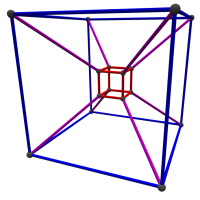
- Cube Rotations – animated video showing proper and improper rotations of the along with the associated rotation matrix.
- The Months – animated video updating older one from years ago.
- Random Post Button – 3D model to replace current button.
- Thumbx and EXIF – image processing software projects.
- N256 – infinite precision numbers software project.
- Expr and Proc – expression processing software projects.
- Template – yet another software project.
- TK – Python GUI I want to start using.
- Unification of img lib – software project.
- Unification of vector and matrix lib – software project.
- #5 Crossbar switch – 3D model for a blog post.
- Crossbar diagrams – 2D graphics for same post.
- The Wheel – 2D graphics project.
- Online courses in quantum mechanics.
- Various queues of books to read.
- Get an exterminator about the damned wasps.
It doesn’t matter what any of that stuff is, it’s just that it’s a lot. And it’s not an exhaustive list. There are quasi-finished projects I use regularly (Thumbx and EXIF are two examples), but which need another pass because they lack features or need upgrading. They’re good enough for what I need them for, but I remind myself I need to get back to them every time I use them. Comparing the pain of diving back in with the pain of their semi-unfinished state, the latter has been winning.
So, I’m seeing why it takes so long to finish a project. The moment I get tired of working on one, I move to another. That starts a chain of jumps from project to project until I happen to get back to the one and move it along some more. Timesharing on a very broad and somewhat random scale.
There is also the unfortunate trait in me that I most love the design challenges of inventing new software or 3D models or images, but once those challenges are solved, the rest is… just work (and I’m retired). Truth is, many of these projects are very much like building ships in bottles — a hobby with no real payoff other than the accomplishment. And for me, that accomplishment lies largely in the design.
§
My former fellow WordPress blogger, Tina from the Diotima’s Ladder blog recently vacated the WordPress premises and started a new online life on Substack [her new blog is Philosophy and Fiction].
In the process of following her new blog, I ended up with an account on Substack. At first, I figured I’d just use it as a point of presence there. I wasn’t planning to start a new blog.
And yet it seems I kinda have, though it remains to be seen how much I pursue it. I have become increasingly dissatisfied with WordPress, and I have some mixed feelings about blogging at all.
It leaves me with three basic options: Maintain; Move; Quit.
Somehow the third option, as tempting as it sometimes seems, just isn’t in me. I enjoy writing too much, although I really want to change the nature of my writing.
For fifty years, most of my writing has been descriptive. Specifically, descriptive of technical things. I dabbled a bit in poetry in high school (what writer doesn’t) and with fiction in college (generally in the form of short screenplays), but most of the writing I’ve done has been science or technical communication of some form.
For my parents (and their computers), for fellow students I was tutoring, for fellow technicians I was mentoring, for customers I was training, for managers and inhouse clients I was working for, and here on my blogs. (All three: one explaining baseball, one explaining programming, and this one explaining whatever else I felt like explaining.)
I’m a child of the early internet (and, sadly, a child of television, but that’s another post). I’m among those who believe in putting what we’ve learned and know out there on the internet, for free, for anyone who wants to learn. Because, to a large degree, that’s how we learned.
It goes back to an earlier tradition of putting knowledge in libraries where anyone can freely access it. There are state secrets and corporate secrets, and rightfully so, but general knowledge should be free to all.
Anyway, I have a new blog, also called Logos con Carne.
I’m not doing a whole lot with it, yet, and don’t know where I’ll take it (if anywhere), but I am enjoying the Substack Notes channel. It’s essentially like Twitter or Facebook, and I’ve never had the former and gave up the latter many years ago, so I’m a little taken with micro-blogging there right now.
§
A couple of years ago, mathematician-educator John Baez had a blog post about the color of infinite temperature, as worked out by mathematician-educator David Madore.

Color of infinite temperature.
When objects are heated, they radiate heat in the form of photons. The wavelength of those photons — what we would perceive as their color — depends on how hot the object is.
If the object is merely warm, the photons are invisible because they’re in the infrared (or even radio) part of the spectrum. As heat increases, objects will glow deep red, bright red, orange, yellow, white, and, if hot enough, blue. If heat increases, the object begins to emit x-rays, then gamma rays of increasing energy (as more heat is applied).
Temperature has an absolute zero, but, as with the real numbers, there is no maximum possible temperature. Theoretically, if not practically, it can be infinite.
The color patch here, on the left half, shows the visible color of infinite temperature as calculated by Madore (#94B1FF). The right half shows the color as calculated by a commenter who got a slightly different result (#9AB5FF). They’re very similar. Suffice to say, pale blue. (Their decimal triplet values are [148, 177, 255] and [154, 181, 255], respectively.)
As John points out, if you could actually see an object with extraordinary temperature (let alone infinite), “you’d instantly be fried by gamma rays of arbitrarily high frequency.” He also mentions that a typical neutron star is hot enough to look like this.
See his post for details!
§ §
Stay pale blue, my friends! Go forth and spread beauty and light.
∇






 Logos con carne
June 7th, 2024 at 12:23 pm
I never would have guessed that something infinitely hot would be periwinkle (or maybe cornflower?) blue.
June 7th, 2024 at 1:08 pm
It’s surprising isn’t it. On his blog post, John calls it “perano” blue.
It’s pale blue because it includes all the other colors of visible light, from deep red to deep blue. From what I’ve read, with extremely hot objects the intensity of the light is based on the square of the frequency, the amount of light from the blue end of the spectrum is about twice as much as from the red end. That makes the overall color, a combination of all visible light, has more blue than red.
And even more x-rays and gamma rays, so a bit hazardous to your health.
June 9th, 2024 at 3:03 pm
Wyrd, you have a way of raising a vastly huge yet interesting topic, e.g., constructing a moral platform, taking a few sniffs then trotting off to sniff a few other trees. You and Bentley may have more in common than you think. I will assume that by “constructing a moral platform” you mean discovering some moral Archimedean point from which we can deduce a moral solution to an issue more or less with the rational resources at our disposal. If I misunderstand, set me straight. If so, then let me remind you that since Descartes and the birth of the Enlightenment Western philosophers have been trying to do just that—sentimentalism, deontology, empiricism, social contract theory, etc., etc., then logical positivism leading to emotivism (i.e., ethics is nonsense). Quite a track record. One of my philosophy professors once said, when you hit a dead end maybe you’re asking the wrong question. Maybe the question is not how to construct a moral platform. Maybe that’s the wrong approach.
Ok, now it’s my turn to go sniff a few other trees. 😉
June 10th, 2024 at 10:39 am
Ha! For exactly the reason you cite, all I can do it sniff and move on. These are, as you say, much-visited trees. (And I have visited them plenty in the very-close-to 13 years of this blog!)
As such, I don’t think I can succeed where others have not. I can’t construct a moral platform, but maybe I can ponder the basic materials for its construction. My first cause, so to speak, is cogito ergo sum, so I exist. Seems I’m stuck in solipsism, though, unless I make the leap of faith to external reality and others like me. So, we exist. Now what? What, if anything, do we owe to each other?
Nature doesn’t offer a satisfying answer, and humans are “better” than nature — we have the understanding and choice nature lacks. My quip about morality being largely about trying to not be an asshole is a rough jazz riff on the Golden Rule, an ancient proposition that I think does form a good kernel. At root, the GR seems a statement of parity, equal treatment. And of personal sovereignty. Kant’s CI seems likewise so. Most religions and spiritual paths involve an equality of “all God’s children.”
If parity and sovereignty are the core, they must be well-grounded. Religion provides one basis — all God’s children. Hard-core materialists, though, seem left a bit hanging. They can’t resort to nature, and they may not even consider consciousness a thing, so all that seems left is something like game theory or, ultimately, fiat.
My main point here is an argument that our consciousness may be, even in the bounds of strict materialism, so rare as to be unique, not just to this galaxy but to all surrounding ones and possibly even within the visible universe. Contrary to the Copernican Principle, we may, in a sense, be the center of the universe. (Or, admittedly, a meaningless tiny speck within its vast material bulk. Always a possibility.) And that might be a basis for materialist ethics.
Even if the odds are much lower and we’re only rare in this galaxy, or in this region of it, it still suggests that higher consciousness alone might be precious enough, special enough, to be seen as a gift we must not squander or mistreat. Even the higher animals seem to have something we should not mistreat. (An important question for our culture being the threshold of “higher”. We don’t generally see our food animals as higher, perhaps in error.)
June 10th, 2024 at 12:11 pm
Ah ha! René Descartes! Well, Descrates’ “cogito” is one of the main contributors to our moral confusions in my opinion. He helped bring forth our modern Enlightenment and shift our focus to epistemological certainty in our philosophical quests—something even modern science totally rejects! I can only imagine the mental strain poor Immanuel Kant suffered as he struggled to formulate his Critique of Practical Reason with mathematical precision. As I’ve said on several blogs I haunt, we all think with Enlightenment formed minds. I think of it as a sort of handicap. I suspect you, with your mathematical gifts, may be particularly plagued. Aristotle expressed it best. We can only expect that level of precision as the subject will permit. By the way, Aristotle never tried to create a “moral platform” as I described and what I suspect you meant—a moral Archimedean point from which we can deduce a moral solution to an issue more or less with the rational resources at our disposal. Perhaps that’s why Aristotle was rediscovered with the revival of virtue ethics post WWII.
By the way, I think good moral thinking can be done outside religion. After all non-Christians get what Jesus was preaching right? Nor need we concern ourselves with our place in the universe. We still have to deal with each other either way right? As I suggested, maybe you’re asking the wrong question. Here’s a hint to help. This is rough. You spent a career developing computer programs, right? Are you able to judge an excellent programer from a mediocre one? I suspect you can. And you can judge that goodness without the help of a moral platform, right? So, the job of giving someone a computer to develop a program ought to go to the excellent programer, right? Aristotle uses the example of a flute and an excellent player. I think you get the point. The example is basic but insightful. We build from there. Just a thought.
June 10th, 2024 at 3:33 pm
Heh, well, I don’t know how much epistemological certainty I have in general or in this case. For me, the clockwork world introduced by Newton and Descartes is just the Yin to the Yang of… something ineffable. And for me, moral discussion is more on the Yang side. My notion of parity through consciousness comes while wearing my strict materialist hat to see where I can get with just the most obvious givens. Cogito ergo sum, whatever Descartes’s other mistakes, to me is a strong argument. It’s all I’m taking from Descartes. I’m also taking the Golden Rule, which is a lot older!
Totally agree moral thinking can be done outside religion. That’s exactly what I’m doing here.
I can judge a skilled programmer or quality employee, but goodness seems a moral judgement to me and far more relative and subjective than the more objective judgements of skill or quality. And, yes, if I have a job to offer, then I prefer to offer it to the most reliable and skilled employee. But they might still be evil (though that would probably disqualify them to me).
June 10th, 2024 at 9:23 pm
Wyrd, you have a tough verbal code to crack my friend. I should have been reading your bon mots from the beginning—I probably could decode you better. I suspect that I probably sound like a voice from another planet let alone another culture. But, I can respond to some of what you say. First, I said that none of us have epistemological certainty. That’s the whole conundrum in philosophy—modern philosophy that is. Descartes set us up with that impossible goal. And it cannot be met. As I said even modern science rejects that standard. If we set that aside we can make great progress as many philosophers in the second half of the 20th Century argue.
Second, and much more importantly, let me respond to this comment: “I can judge a skilled programmer or quality employee, but goodness seems a moral judgement to me and far more relative and subjective than the more objective judgements of skill or quality.”
I understand your skepticism. You agree that you can judge a good programmer. Let me build on that. I’m sure there are disagreements around the margins, but wouldn’t we all agree on the virtues that make a good son? Don’t you judge whether you are indeed a good son by a set of virtues we probably all agree on? Likewise, I think you can enumerate the virtues of good father, a good friend, a good citizen, and many other roles that may define your life. Are these not moral judgments on goodness? Sure we disagree around the margins and we debate and adjust those margins. Goodness is a moral judgment, yes. But not some special “add-on” quality. It’s built into the roles we inherit and take on. Our various roles in life come with moral standards. And it is done quite objectively. That has been my point from the beginning—a point lost when the Enlightenment decided it had to start fresh Descartes’ cogito, his demand for epistemological certainly.
June 11th, 2024 at 8:58 am
What seems a tough code is more likely my own not keeping up here rather than anything deep. I’m not exactly following you on your issues with Descartes. My understanding was that he denied the certainty of everything except that he existed. Are you disputing cogito ergo sum? Or do you mean his search for certainty? One that, as you say, mathematicians and physicists come to utterly smash.
“wouldn’t we all agree on the virtues that make a good son?”
I’m not certain that we would. I think the notion of a “good son” can be both personally and culturally dependent. (A convicted felon, for instance, might consider good sons to be ones that bear false witness.) Likewise, the other “good” ones you listed: father, friend, citizen.
What I think you’re getting at is what I refer to as the “body of normative Western art and (particularly) literature”. I think that’s where most of our generic ideas of a “good” child, parent, friend, or citizen come from. We have many centuries of stories depicting behavior and consequences. (What I think bothers so many of us about the behavior of the Right these days is their violation of these normative traditions. A violation that’s been surprisingly effective.)
I suppose an interesting question involves how that body of literature came to be. Is it a document just of what worked — humanity feeling its way — or is it reflective of something deeper?
But it may be that I’m just not on the same wavelength with what you’re trying to say. No doubt the confusion is mine!
June 11th, 2024 at 10:59 am
In his Discourse on Method, René Descartes decides that all this beliefs can be doubted. He wants to find what, if anything, he may believe with absolute certainty. He describes his method for uncovering truth. He will reject “as absolutely false everything in which I could imagine the least doubt.” He concludes that there is only one belief that survives this method: The Cogito. He then decides to built up from that point—his Archimedean point so to speak. Descartes’ method has had a profound effect of Western philosophy and cemented (some would say) an overly restrictive concern for certainty in our philosophical inquiries for 500 years. Nothing more profound than that! Beyond that I feel I should leave it. I am apparently unable to write clear enough to make myself understood.
You’re not certain we would agree on the virtues of a good son? I had no idea the world was so chaotic. I hope that at least you and your father agreed. And if you don’t believe that one—or I suspect much of the community—could engage the criminal mind in an argument that his unique list of kindred virtues was pathological, inconsistent and ultimately malignant to a healthy community, then again I should leave it. My quest was only to show that moral goodness is not some special quality that exists outside our lives but that we engage with it every day and agree on much. Nothing more profound than that! I have obviously failed. I suggest you quest in the enchanted forested for the elusive moral goodness you seek.
June 11th, 2024 at 3:36 pm
My apologies, I fear I have frustrated you. I recently had a discussion with a mathematician about the Axiom of Choice. The conversation got complicated because I thought there was more to the AoC than there is. Based on previous attempts to understand it, I was looking for something mathematically complex and hard to understand, but it’s actually so simple as to be trivial. It is just the assertion that, given a bunch of non-empty bins, you can always take an item from each. Trivial (and yet controversial).
I think I may have given you an impression I’m after something here that is much deeper than I really am. I’m not trying to build a moral platform — I agree that’s a formidable undertaking. I’m more pondering where to even start. For theists, it’s received, but where do materialists start? (Hence my two starting points, I exist, and others with parity to me exist.)
I agree about pathological viewpoints, but my question is what allows us to so label them? Is the notion of a healthy community axiomatically good, or do we need to ground it? Much we consider inimical is also effective. What makes a muddled egalitarianism preferable to effective and productive tyranny? These seem hard questions to answer from a materialist point of view, and I thought maybe the twin notions of consciousness, of self and others, was a starting point.
Philosophy before or after Descartes is outside my scope. I’m just taking cogito, nothing else. I think that’s an important step. But I think the next step, other minds, is more important.
I agree about certainty (and the mechanical outlook) of Western thought. I’ve known that to be false since I learned about the Heisenberg Uncertain Principle back in high school. I also agree we constantly make moral judgements, but what do we base them on? Why isn’t it some special quality we must consider? Is it innate to consciousness? (In fact, I do suspect a causal correlation between high intelligence and moral sense, but I’ve had that laughed at by some.)
June 12th, 2024 at 12:29 pm
Wyrd, not to worry. I’ll get over it. You know sometimes making entries in a blog is like attending a cocktail party. You stand there with a drink in your hand, making a point to someone, thinking they are listening to you when, in fact, they are waiting for their turn to express their own views on a subject—making them sound vaguely like a response to what you said. Ah! The frustration!
To explain my confusion let me repeat some dialog. I’ll stick with a simple point I tried to make—more than once. My first attempt: “Descrates’ ‘cogito’ is one of the main contributors to our moral confusions… He helped … shift our focus to epistemological certainty…” My second attempt: “…I said that none of us have epistemological certainty. That’s the whole conundrum in … modern philosophy that is. Descartes set us up with that impossible goal.” My third attempt: In his Discourse on Method, René Descartes decides … to find what, if anything, he may believe with absolute certainty. … He concludes that there is only one belief that survives this method: The Cogito. … Descartes’ method has had a profound effect of Western philosophy… [It] cemented … an overly restrictive concern for certainty in our philosophical inquiries.”
Then you sing the phrases of the cogito—apparently unwilling to follow my point. “My first cause, so to speak, is cogito ergo sum.” (By the way, not clear what the heck first cause means.) You then say “I’m just taking cogito, nothing else. … Cogito ergo sum, whatever Descartes’s other mistakes, to me is a strong argument.” … I’m not exactly following you on your issues with Descartes. My understanding was that he denied the certainty of everything except that he existed. Are you disputing cogito ergo sum? Or do you mean his search for certainty?” Then you state quite surprisingly that “I agree about certainty … of Western thought.” What?! That would mean you agree that Western thought, since the Enlightenment, was needlessly fixated on an unattainable level of certainty—i.e., that level expressed by the cogito. So what is it, my friend? Or, maybe you mean something totally different. I give up. This cocktail party is becoming tedious, my friend.
June 12th, 2024 at 7:56 pm
Definitely some crossed wires here. Let’s see if we can uncross them. I’ve understood your point about Descartes and Western Philosophy from the beginning. But I haven’t understood the connection to the far more basic, and I thought unrelated, points I’ve raised.
Forget Descartes. Imagine the notion of cogito ergo sum comes from somewhere else. I asked if you disputed the notion — that it demonstrates our own existence — but I didn’t get an answer. Do you have an issue with this particular certainty?
As a worldview, I think the mechanistic view of reality — the Yin — misses the Yang of the ineffable, the mystical, the religious, the deeply complexly human. And even in the material world there is knowledge forever beyond even our theoretical grasp. But there is no uncertainty in the single (and singular) fact I exist.
The dissonance between that singular certainty and everything else has always been one of my takeaways from Descartes. Contrary to everything else, we can at least count on our own existence. Is it that starting point that’s the issue?
Stuck on this starting point, we never got to the next point (a leap of faith: others exist). But alas, I suspect I’ve used up your patience.
June 13th, 2024 at 6:56 am
Wyrd, Let’s look at what you asked, it will be instructive. “I asked if you disputed the notion — that it demonstrates our own existence — but I didn’t get an answer.”
The question Descartes was attempting to answer was: What can we know with absolute certainty? His thesis question was NOT do I exist? That was not his concern. The “cogito” is not Descartes’ proof of existence. It is the first step in a “method” of philosophical inquiry. His goal was purely epistemological. When a philosopher uses the term “cogito” he is referring to Descartes’ epistemological method. You have bastardized the term. You use it in a unique manner for your own purposes which would be confusing to anyone familiar with Descartes’ Meditations. I assume you never read the Meditations or took a class on Descartes. “Cogito” is a term of art for philosophers. To say “cogito” to a philosopher means a specific set of things which you ignore or perhaps do not appreciate. Anyway, that’s why I never gave you an answer—the question, in that context, is incoherent.
June 13th, 2024 at 9:37 am
I will grant you that, in isolation, the idea that I experience myself having thoughts, a subjective experience of thinking, can be evidence that one may exist. I think more needs to be said. However, to give that the “cogito” label is, to say the least, confusing. I think for Descartes that fact that he experienced subjective experiences—a mind at work—was an intuitive given or starting point. Intuitively he felt it was an absolute certainty and he could build on that certainty. So much more philosophical baggage comes with that term than the fact that Descartes existed. In fact, in Descartes day, one criticism of his formulation was that it went too far. It may only show that “thinking” exists not that Descartes exists.
June 13th, 2024 at 1:24 pm
I’ve gone from tedious to incoherent. 😊 We don’t seem to be getting through to each other, but maybe this gets to the heart of it:
“You have bastardized the [cogito]. You use it in a unique manner for your own purposes …”
Yes! Exactly. That’s what I do. Take the bits and pieces I encounter that seem valid and useful. And I make no claim of knowledge about the study of philosophy, let alone that I am a philosopher. I’m just a guy having thoughts.
[In fact, for a long time my three keywords were “teacher”, “artist”, and “philosopher”, but I dropped the last one after deciding I wasn’t worthy of that label. I’m still seeking a third keyword. Possibly “writer” though I’m not confident I’m worthy of that, either. “Student” might be better.]
“… which would be confusing to anyone familiar with Descartes’ Meditations.”
That’s unfortunate but I suppose an unavoidable consequence of my tabula rasa approach. I must point out that, in the post, I never mentioned Descartes or his famous phrase. I spoke only of consciousness.
As you say:
“I think for Descartes that fact that he experienced subjective experiences—a mind at work—was an intuitive given or starting point.”
Yes. As it is an intuitive given and starting point for my thoughts about the parity and soveriegnty of consciousness as a materialist basis for grounding a moral outlook.
I think perhaps you were seeing a silk purse where there was only a sow’s ear! This was just a bone tossed to strict materialists.
June 13th, 2024 at 3:33 pm
All I wanted was a meaty discussion of “moral goodness.” Instead I fell into a loop. Reminds me of the early computer days. In other words, I need a gin and tonic! Another time. 🙂
Pax vobis, my friend.