 The implied image in my last post — of a sea creature returning to the surface — turned out to be more apt than intended. I descended again to finish my project and my burn-out. Spent a few days on the couch reading to recuperate (the library was nagging me about people waiting for books I borrowed and wasn’t reading).
So, let’s try this resurfacing thing again. I have more than books to catch up on. And two posts that should have come before this, but here we are on the penultimate Friday in November.
I have plans next weekend, so it’s Friday Notes now or never (in November).
The main thing that’s been keeping me deeply submerged is the Unfolding Cube movie I’ve been working on. Last time I linked to the first production version, Cube Nets v1.0. My second dive moved the project into a more colorful domain. Here’s Cube Nets v2.1:
The dot-one update because of an unnoticed bug in v2.0 (a missing cube net in the intro slides) as well as some minor improvements elsewhere. But I now consider the project finished and can move on!
I don’t normally give much thought to line-count, but I was curious how many lines of Python code the project had (3,239) and noticed one of the files (cubenet_defs.py) has exactly 1337 lines. (A joke only computer geeks will get.)
§
I’m way late to this game, but one thing that made my project work more fun was finally getting into Windows virtual desktops (properly called Task View). Now I’m kicking myself over not getting into them sooner. It didn’t take me long to have five virtual desktops I switch between depending on what I’m doing.
One for email and blogging, one for Python coding, one for POV-Ray 3D rendering, one for building the animations and converting them to YouTube movies, and one for whatever sub-tasks that spring up.
Programming has in common with some kinds of manufacturing (and some kinds of filmmaking) that before you can make the intended product you have to make the tools that make the product. (Occasionally, it’s tools to make the tools to make the product.) The project above was this way. The Python code I wrote is the tool that allows POV-Ray (and ffmpeg) to make the product.
Point is, it’s not uncommon for me to be doing something with POV-Ray or Python and need to jump to a sub-task before I can continue. It’s really nice having a whole new desktop I can jump to. More importantly, to be able to return to where I was on the other desktop with nothing disturbed.
If you do a lot of computer work and haven’t tapped into this ability, I — a curmudgeonly very late adapter — highly recommend it!
§
What’s the word for phrases we use routinely but which no longer refer to actual things? For instance, “roll camera” (or “roll tape” or even “roll film”) — neither still nor motion cameras tend to use tape, let alone film, anymore.
Very few ships actually “set sail” anymore.
Closer to home, “dialing” or “hanging up” a phone. Phones can’t even be “off the hook” anymore (everything has gone “off the leash” and “off the reservation”).
There’s a word for phrases like that…
§
Interesting how many ways we can modify some nouns. “Writer” is one example: struggling writer, [un]published writer, [un]known writer, [un]successful writer, good writer, bad writer, [in]experienced writer, [un]popular writer, hack writer, expert writer, technical writer, genre writer, {insert-genre} writer, great writer, “not much of a” writer, amateur writer, professional writer, award-winning writer, distinguished writer, budding writer, former writer, alcoholic writer, radical writer, mainstream writer, short-story writer, classical writer, modern writer, {insert-era} writer, diary writer, sports writer, sob-story writer, children’s story writer, living writer, dead writer, long-dead writer, …
The list goes on (and on). One could make a similar list for musicians and many other human pursuits and professions. Are there natural things as prone to such variety? Mountains? Trees? Dogs? I think maybe those things, wonderful as they are, aren’t as complex and maybe don’t attract so many adjectives.
§
Speaking of word lists, I’ve long been amused and bemused by the alphabet soup of my (former) profession (and current hobby): PC, DNS, TCP/IP, BBS, FTP, HTML, CSS, JS, http, nntp, ntp, uucp, csh, bsh, bash, ksh, awk, AJAX, REST, XML, XSD, XSLT, WSDL, SQL, ODBC, JDBC, J2EE, JMS, SAX, ASM, BASIC, C, C++, PL/1, BCPL, APL, COBOL, SNOBOL, and FUBAR. The soup vat is filled with others.
Lots of fun words, too: Wi-Fi, Telnet, Fortran, Lisp, Algol, Ada, Eifel, Haskell, Pascal, Python, Smalltalk, and foobar (including foo and bar).
I’m hoping having to remember all this helps stave off senility…
§
When I needed a break from The Project, I shifted to some other projects that needed attention. I finished my software model of the Enigma machine, for instance. And I updated this:
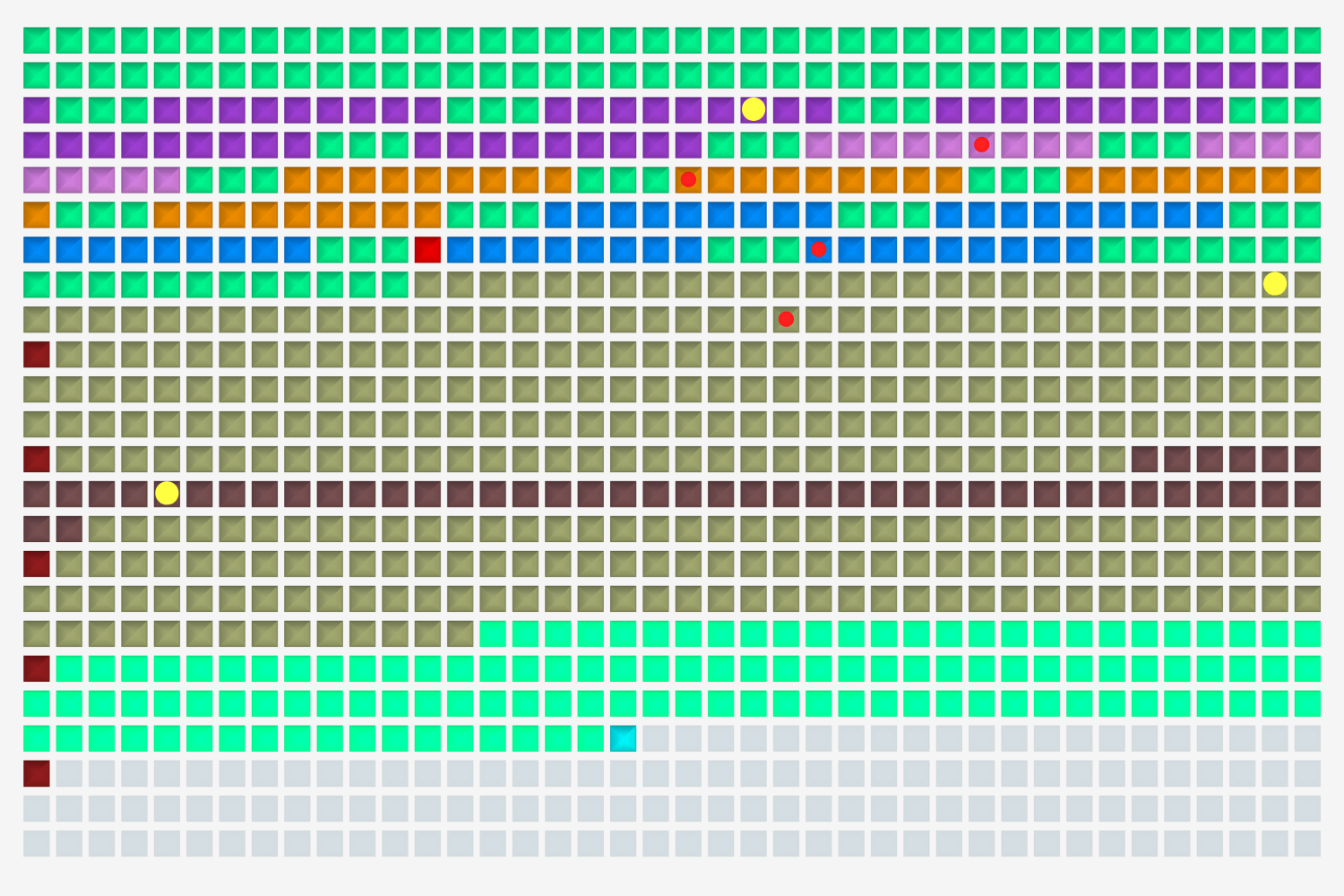
960 Months (80 Years).
[click for 1500×1000 pixel version]
Which is based on a web comic I saw a long time ago that, with an illustration similar to the above, drives home the point that, assuming one lives to the ripe old age of 80 (78 in the original comic), there are only 960 months in that lifetime (936 in the comic).
Which doesn’t seem like a lot considering how quickly a month passes.
I re-rendered the image to bring it up to date. The bright blue stone at the end of the rows of retirement spring green is where I am now in those 960 months. Colors code various phases of the past. That long tan section is my career at The Company. That dark band in the middle of that is my all-too-brief marriage.
The purple sections are grade and junior school, the orange is high school, and the dark blue is college (yes, five years, I took a year between junior and senior years to focus on my senior project — little realizing that would activate demands for repayment of my student loan).
The green sections reflect free time in general, but it’s nice to see that stretch of retirement spring green grow since the last time I rendered this. Long ago, I made a YouTube video for this. I think I can make a better one now that I’ve learned more and have some better tools.
§
The probabilities of the past are always 100%. The probabilities of the future are just predictions. Usually incorrect ones.
I dunno. It sounded interesting when I wrote it down.
§
As I continue to explore blues rock (listening to Joanne Shaw Taylor at the moment), I’ve developed a minor pet peeve: recordings of live concerts with lots of talking to the audience. Especially any long-winded introductions of the musicians. Because you have to go through it every time you listen to the album, and it gets way older than the music.
Which in itself is interesting. We can listen to the same song many, many times without “wearing it out” (although it is possible to do). Poetry also withstands many repetitions. Songs and poems often benefit from those repetitions.
Books and movies seem more specific, more concrete, and less prone to the same number of repetitions. The exception can be books or movies we especially love, but even there I suspect the repetition count is less than for songs or poems.
Campfires, ocean waves, and clouds don’t seem to get old, either. (Nor, really, does music or human beings.) Maybe it’s me, but I think the more specific something is, the more prone it is to over-familiarity, which breeds, if not contempt, at least some ennui.
§
Notes for a post I probably will never get around to writing: Berman’s Vulcans (redux) and the notion of modern “relatable” characters.
I don’t fully understand the notion that people only relate to story characters they identify with or, at least, are just like them. This applies to race, age, gender, and sometimes even education and intelligence. At the same time, we seem to limit horizons and fear aspirations. Berman’s Vulcans was about how modern writing turned the Vulcans from something noble and aspirational to not just assholes like humans, but assholes with a superiority complex.
Modern insecurity. Perhaps a byproduct of a world that’s gotten too complicated to understand?
Worse, decades of deconstruction (beginning with Watergate and Vietnam) have sidelined or corrupted our role models, personal and institutional. Not just that nothing is sacred, but that nothing is worthy.
We have a fear of winners — all those “participation” awards. When everyone is a winner, no one is a winner.
And we fear the implications because everything means something but since nothing really means anything anymore, the meaning we take is arbitrary, often capricious, and sometimes deliberately false.
I can’t help but think society is fraying around the edges lately. Needs something to knit up the raveled sleeve of care.
§
Notes from another post I’ll likely never get around to writing: Let’s Be Rational.
The real world may use rational numbers rather than real numbers. (Which is ironic: the world is rational but not real.) Real numbers present a host of subtle issues, and one solution is that we made them up.
Even though the rational numbers have island properties, they can be enumerated, so there is a bridge to each (which the real numbers don’t have). Of course, both the rational numbers and the real numbers can be sorted.
I’ve long clung to the notion that spacetime is smooth, but it seems an increasingly faint hope. Einstein’s General Relativity has a smooth spacetime, and I like to think old Al got that right.
At least until quantum gravity is solved, hope remains!
§
Another little side project, generating this diagram:

Which I am going to post about. Now that I have the diagram, the post is a lot closer.
§
From the Swiss Cheese Brain files: the last week or so I’ve been engaged in a great discussion that started with the question of correlation between STEM-trained folks and a disposition to authoritarianism and drifted from issues with technocracy to issues with meritocracy.
The holes-in-my-brain part is coming across this note from long before the current discussion. A note I’d completely forgotten!
Meritocracy
Starts with recognizing (and acknowledging) the problem (which, as usual, is that Bonhoeffer was right). Bluntly put, how does a society deal with the stupid and particularly the willfully stupid.
A meritocracy is obviously worthwhile in at least some areas. We already require demonstrable merit in many professions: airline pilots, surgeons, musicians, lawyers, bankers, and many others.
But often not in key areas, such as politics, government, or management. Incompetence is easily disguised in these areas, so they become the refuge of the mediocre. We should demand more from them, as we do with pilots, surgeons and others we depend upon.
Art and fashion are interesting because they depend so much on public perception. Both the good and the bad can succeed or fail here.
Indeed, politics is often more like art or fashion in how it depends on public perception. Which is fine, perhaps it is more an art, but we should still insist on demonstrable capability from those who affect our lives.
§
I may, or may not, post much in the months ahead. I can feel myself retreating into a winter shell. The time change kind of kicked my ass this year. The early dark is really depressing. At least the weather has been decent, but I know that will change.
I seem to be in a reclusive mood these days. A strong desire to shut out the crazy ass world and just work on my little projects, my little ships in bottles. Keeps me happy and challenged. And it would be nice to finish a bunch of nearly finished ones. I have a tendency, with personal projects, to lose interest once I’ve solved all the challenges and the rest is just work. Their primary value to me is the challenges they present. Completing them usually doesn’t have much value. I’m not likely to find much use for an Enigma machine or a Turing machine, but it was fun designing and implementing them.
But it’s also kind of nice wrapping them up and moving them from the workspace folders to the apps folders. I’d like to devote my energies to that so long as the mood persists!
§ §
Working on these projects involves generating and deleting lots of (image) files. And I can’t help thinking about how all that organizing of bits involves serious but very temporary reductions of entropy. Billions of bits brought into a perfect state only to be randomized and blown away like dead leaves in the wind.
Like all of life.
Stay probable, my friends! Go forth and spread beauty and light.
∇





 Logos con carne
November 17th, 2023 at 3:36 pm
I’ve got my sights set on the Solstice: Dec 22, 03:28 GMT (21:28 CDT Dec 21)
When the days will start getting long again (eventually).
November 18th, 2023 at 1:55 pm
Me, too!!!
November 18th, 2023 at 9:30 am
First, I enjoyed our very brief sojourn (on another blog) into exploring the relationships among the STEM educated, technocracy, authoritarianism, and meritocracy. I had hoped you’d contribute a bit more. You whetted my appetite to explore what I think is an overlooked area of political theory. That aside, perhaps I can offer a little something to (perhaps) alleviate your depressing and reclusive mood these days. Let me suggest a habit common in the Nordic countries. The Nordic people make heavy use of “candle light” during the long dark winter months. Candle light is qualitatively different from electric lights. And, I submit, it has a positive effect on one’s mood. For me, I also make a wood fire almost every day in the winter which has another effect, a qualitatively different and more satisfying form of “heat” which also affects my winter mood. In fact, I have a wood burning fireplace in my kitchen where my wife and I tend to spend most of our time while at home. A major source of heat (usually a ceramic wood burner) a common feature in many Nordic homes as well. They have lived in though cold dark winters for many years. Maybe they are on to something. 🙂
November 18th, 2023 at 2:06 pm
I’m trying to make the most of winter’s positives, as well. Holing up in the coziest ways I can. Saying “yes” to fires and reading and hot cocoa and a wide variety of simple, hearty soups and stews! And warm blankets and quiet projects around the house. Anything that makes me happy and helps me feel the contrast between the safe, soft warmth of my home and the long, cold, dark of winter surrounding that.
November 19th, 2023 at 10:14 am
Some good advice there. All four of my grandparents came here from Norway, so I have a sense of what those long winter months were like for them. (I had a friend who lived in Borrow, Alaska, for a year. Months of darkness. Also months of a Sun that never sets. Weird place. In more ways than one!)
Sadly, I lack anything but a gas fireplace — the joys of condo living — but my projects, reading, and music (and some warm blankets, too) are how I get through the days, winter or otherwise. I think I do suffer slightly from SAD. Brighter LED bulbs help that. And sometimes the occasional outside fire in someone’s backyard. Several of my friends have firepits.
And, honestly, since I retired, or at least a few years after, it taking some time to normalize, I don’t suffer the lows I used to (see When the Dark Comes for instance). Winter and the holiday season can be a bit rough, but I manage to weather it. Mostly by keeping my head down until the light returns in late January/early February!
November 19th, 2023 at 11:06 am
Well, we can certainly continue to feed our appetites. People gotta eat! 😃
Thinking about the criticisms of meritocracy, the ones inherent to it, I wonder if it isn’t true that all socio-political systems stratify people. The question is along what metric. Currently, it’s largely economics, ancestry, race, gender, even tradition. Would a stratification by merit be worse, a different kind of same, or better? Assuming it replaces some of the current metrics. My background (and biases) suggest it could be better. Which may be the flaw you originally identified in the STEM-trained — the inability to see past merit, to see true value in what logical analysis deems trivial, ephemeral, or beside the point.
Maybe the core tension here is between the cruelty of physical facts and logical analysis versus the warmth of often blind human compassion and love. I differentiate between logical and rational, because I think the latter includes the Yin-Yang of logic-compassion (of Spock-McCoy). I would go so far as to say that I consider it rational to sometimes be irrational. All work and no play…
One question might be how easy different forms of stratification are to overcome from within the system. Race, ancestry, or gender don’t offer much chance of change; those changes have to be external and systemic, which is hard. Economic equality is more attainable but still a challenge. “The rich get richer…” Within most systems, especially capitalism, economic stratification tends to grow.
But skills and education, especially in a world with so much knowledge freely available, like a garden, are things most people can grow if they really want to. I would guess that more people raise themselves intellectually than financially. And often the former leads to the latter. So, while I cannot deny the stratification of a meritocracy, I think I see it as a least-worst form compared to others. In part because it seems the most easily cured. (I would reaffirm my belief that a good education is key to solving many social problems.)
As I’ve said before, speculations of a more utopic society aside, I mostly wish we expected the same level of excellence, or anything like it, of politicians, government, and corporations as we do pilots, surgeons, and musicians. In the latter group, on-going mistakes or inability is grounds for dismissal. In the former group, it sometimes leads to promotion.
As an irrelevant aside, there is enough overlap between science and art (lots of scientists and technicians are musicians, for instance) that some like the term STEAM — the added ‘A’ standing for Art. I wonder if perhaps there should be a ‘P’ for Philosophy. STEAMP! STEAMP out ignorance!
November 18th, 2023 at 3:07 pm
Is the word you’re looking for ‘anachronism’?
November 19th, 2023 at 10:05 am
Maybe? The word definitely works, but I think (maybe?) there was a more specific work, a term of art, as it were, for phrases still commonly used but which no long refer to anything current. Anachronisms generally aren’t in current use. “Buggy whip” versus “dialing a phone”.
Of course, I could be unconsciously making all this up. But I thought there was a word… 🤔
November 22nd, 2023 at 3:11 pm
Ah, yeah you’re right. Couldn’t be anachronism, but I have no idea what it is!