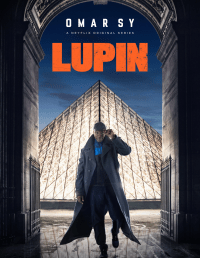
 Back in March I posted about the Japanese media franchise Lupin the Third. The main character is the grandson of the fictional thief Arsène Lupin from the stories by French author Maurice Leblanc (1864-1941). Last month, I posted about a Japanese live-action series that isn’t connected with the franchise and only implies the fictional French thief.
For TV Tuesday this month, I’m posting about the French standalone live-action series Lupin. Here the references are explicit. When he was young, the main character fell in love with the stories of Leblanc and based his own life (as a thief) on the fictional Arsène Lupin.
And, as usual lately, I’ll mention some movies I watched on television.
Lupin (2021-present, two seasons, five episodes each, Netflix) is the creation of George Kay and François Uzan. It stars Omar Sy, an award-winning French actor, who plays Assane Diop, a gentleman thief who tried to imitate the fictional Lupin. I’ll say now that I have mixed feelings about the series. It was generally engrossing, but I have a number of complaints.
In the first episode, Assane Diop plans and executes the heist of a valuable diamond necklace that once belonged to Marie-Antoinette. The necklace had been on display at the Louvre prior to being sold in an auction (held at the Louvre).
In the backstory that develops as the series progresses, it turns out that Assane’s father Babakar Diop (Fargass Assandé), who worked for the rich and powerful Pellegrini family, was accused of stealing the necklace from them when Assane was a child. His father later confessed to the crime and hung himself in prison. (If you have any sense of narrative, it’s obvious there is more to this than first appears.)
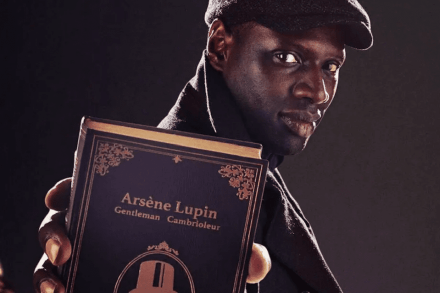
Assane Diop (Omar Sy) displaying one of Maurice Leblanc’s books about the gentleman thief Arsène Lupin.
The necklace was recovered soon after that first theft and has been in possession of the Pellegrini family ever since. Now they’re auctioning it off for a vast fortune, but Assane has resolved to steal it. He uses a false identity as “Paul Sernine” — a supposedly wealthy entrepreneur — to bid for, and win, the necklace. (That fake name is an anagram for Arsene Lupin, as are other of his fake names.)
But he’s betrayed by the small gang of loan sharks he recruited to stage the heist. At a crucial point they attack, steal the necklace from him, and escape leaving him behind.
Their escape doesn’t go as planned, and they’re captured with the necklace. Except (minor first episode spoiler) that it turns out the necklace in their possession is a fake. Assane switched them and escaped the Louvre with the real one.
Which made for an engaging first episode. Unfortunately for heist fans, it’s the only noteworthy heist in the series so far. (A third season is due this October.) The overall story is about Assane’s revenge on the Pellegrini family for his father’s imprisonment and death. As such, the series isn’t anything like the Japanese Lupin the Third franchise or the Japanese live-action series Daughter of Lupin [see TV Tuesday 5/16/23].

Assane Diop (Omar Sy, right), his best friend Benjamin Ferel (Antoine Gouy, middle), and J’accuse the dog (left).
As the story progresses, both in the present and past, we learn more about Assane, his school days best friend and current partner-in-crime Benjamin Ferel (Antoine Gouy), his estranged wife Claire (Ludivine Sagnier), his son Raoul (Etan Simon), the Pellegrini family, and what actually happened to his father.
While I’m not hugely whelmed by the series (although it’s a lot better than most of the crap on television these days), it’s good enough that I don’t want to spoil it too much. Suffice to say that Hubert Pellegrini (Hervé Pierre) is a villain of the highest order. Through his wealth and some blackmail, he has the police in his pocket and is free to do largely whatever he wants (including murder).
I’ll also mention that, while the first season ends with a major cliffhanger, the second season does wrap up the basic arc of Assane’s revenge against Hubert. On the other hand, as a consequence of that revenge, Assane is even more on the run from police than ever. But one can watch the first two seasons without being left too much hanging from a cliff.
A secondary story arc involves Assane’s relationship with his estranged wife Claire and his son Raoul. Assane’s father gave him one of Maurice Leblanc’s books about Arsène Lupin, and now Assane repeats history by giving Raoul one as well.

Assane Diop (Omar Sy, right), his estranged wife Claire (Ludivine Sagnier, center), and his son Raoul (Etan Simon, left).
One aspect of the second season I will spoil, so if you really don’t want to know, skip the next paragraph. Once again, a good sense of narrative should make it obvious, but they do let you hang for a while before they drop the other shoe.
SPOILER: The season one cliffhanger involves the kidnapping of Assane’s son Raoul by Hubert Pellegrini’s murderous henchman in an attempt to draw Assane out into the open so they can kill him. They give you reason to believe Raoul is burned to death while trapped in the trunk of a burning car. But only the darkest of stories would kill off a kid (or a dog), and they don’t go quite that far.
The above spoiler might be important if, as with some people I know (somewhat including myself), children in jeopardy is a major emotional trigger. I was pretty shocked although I was also fairly sure things weren’t as they appeared. That said, I’m not entirely thrilled with that scene. It was one of my multiple complaints about the series.
And it ties into a more general complaint about appearances. The scene is mainly a cheap way to shock the viewer and didn’t seem particularly crucial to the plot.

Assane Diop (Omar Sy, right) and Hubert’s daughter Juliette Pellegrini (Clotilde Hesme). They knew each other as kids when Assane’s dad worked for Hubert. They had a romantic connection that lingers into the present.
There were other times when the tension seemed artificial. For instance, there’s a scene later in the second season where Assane is concealed in a crate and almost discovered by a suspicious policeman, but both the initial suspicion and the way the policeman suddenly decides not to bother looking further felt very forced.
In general, the show was what I call “iconic”. I don’t mean that in the older sense of “revered” or “famously distinctive” but in the more modern sense of desktop icons. That is, the use of visual cliches that are a shorthand for imagined realities.
A good example is the canonical icon of yanking a few wires out from under a car’s steering column and (usually without any tools) baring two key wires and shorting them together to start the car. The canonical icon of “hotwiring” a car. Firstly, that’s a lot harder than it looks. At the very least, you need to know which wires to use. Secondly, most modern cars just don’t work that way. Thirdly, most cars lock the steering column when the key is removed, so even if you could start the car, you couldn’t steer it.
So that canonical icon of hotwiring a car is a cheap visual cheat. Because plot.
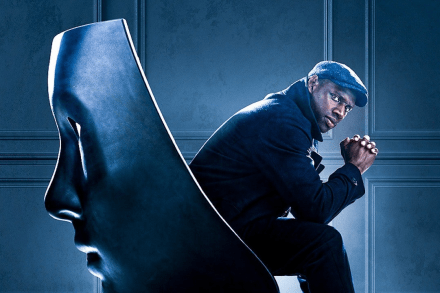
Assane Diop (Omar Sy) and his cool mask chair.
There are skills Assane has that seem downright magical. There’s a scene where he grasps the wrists of someone who is handcuffed and voilà, now the handcuffs are on Assane’s wrists. There is very little authenticity to what Assane can accomplish. It’s downright comic book. For me, that detracted from an otherwise generally realistic and gritty story.
I also noticed that Assane’s fighting skill vary depending on plot. Sometimes he’s an excellent fighter (when the plot needs him to win), but other times not so much (when the plot needs him to lose).
In general, people are surprisingly smart (making leaps of intuition) when the plot needs to move along but suddenly stupid when the plot needs to advance around them. For example, Assane’s best friend Benjamin, despite his years of experience, is unaware he’s trailed to Assane’s lair. And in that lair, Assane has nothing in the way of security measures, so a Bad Guy sneaks right in. Because plot.
Assane is supposedly a master of disguises, but the show shoots itself in the foot when Claire spots him after just glancing at a newspaper photo of him in disguise. Most of his disguises seemed pretty transparent to me. I did wonder if there was something of a sly reference to how all Black people supposedly look alike to whites. The show did show the racial prejudices of some people more than once.
§
Lastly, a Lupin the Third reference and a Big Question. There’s a small yellow car Assane and Benjamin drive near the end of the second season (or possibly earlier and I didn’t notice). I’m sure that’s a reference to the car Lupin III and his crew drive.
And what happened to the dog? Assane acquires a dog (named J’accuse), but when Assane is forced to flee his lair, he doesn’t take J’accuse with him. The dog suddenly vanishes from the story. I’ll be interested to see if he shows up again in the third season.
§ §
Some fun and/or worthwhile movies you can watch on TV (all are currently available on Amazon Prime):
§
 Enter the Fat Dragon (2020), a comedy-action film starring Donnie Yen in a fat suit. It’s a remake of a same-named 1978 film by Sammo Hung.
It has some fun references to Kill Zone (2005), which starred Donnie Yen and Sammo Hung, and to Flashpoint (2007), also starring Donnie Yen. Wilson Yip directed both. It also has references to Bruce Lee films and the John Woo classic Hard Boiled (1992).
Reminded me a little of a Jackie Chan action-comedy, especially given the outtakes and short clips during the credits. (Of course, these days, just about everyone does that.) Highly recommended for any genre fan.
§
Raging Fire (2021). Donnie Yen in a very serious action role. He plays a cop facing a former protege turned (very) bad.
It’s not bad. Worth seeing for genre or Donnie Yen fans. There’s a city shootout and some interactions between the two main characters that reminded of Heat (1995) with Pacino and De Niro.
§
The Knight of Shadows (2019). A Jackie Chan fantasy-action-comedy that’s mostly CGI and wire work. I give it a Meh! rating (or a very low Eh! rating). Ok for a Jackie Chan fix. All the CGI makes it mostly eye-candy. Fun for your kids maybe.
§
Legend of the Red Dragon (1994). Also called The New Legend of Shaolin. Stars Jet Li. A traditional style martial arts film with some fun moments. Lots of wirework. Good for fans of the older Chinese martial arts movies.
§
Honorable mention:
The Grandmaster of Kung Fu (2019). A period piece set near the end of the Qing Dynasty (around 1900). The tension comes from the Japanese invading Tianjin and trying to take over martial arts there. The final fight scene is between a Chinese Kung Fu grandmaster and a Japanese aikido grandmaster.
Ip Man: The Awakening (2021). A story about the famous true-life Wing Chun grandmaster Ip Man (who trained Bruce Lee). The story takes place when he was young and features a final big fight against the story’s main villain.
§ §
By the way, Amazon Prime has Top Gun (1986) and Top Gun: Maverick (2022) but the former is only available until the end of this month. Great double feature if you act now.
Stay honest, my friends! Go forth and spread beauty and light.
∇





 Logos con carne
June 20th, 2023 at 4:26 pm
One thing that took me out of the story just a tiny bit was the gut on Omar Sy. You’d think a master thief would be in a bit better shape. All that good French cooking, I assume.
June 20th, 2023 at 4:32 pm
I seem to be doing a lot of TV Tuesday posts lately. It’s entirely possible I watch too much television, but I did grow up with the medium. 🤷🏼♂️
June 27th, 2023 at 9:05 am
Only seven views in a week. Once again, posts about shows starring Black actors seem to be more or less ignored by readers. Very disappointing.
September 4th, 2023 at 7:20 pm
[…] Lastly, there was a French live-action show, Lupin, with a contemporary character, a thief who based his life on Arsène Lupin. As such, the show is filled with overt references to Maurice LeBlanc’s books. [See TV Tuesday 6/20/23] […]