 We live in a noisy world. It was never quiet, but what used to be a natural background has become an artificial assault constantly seeking to capture and at all costs hold our attention.
Rather than wind, waves, or animals, the modern blare comes generally from two sources: The sellers and each other. The internet granted upon us — for better or worse — the ability to be noisy on a global scale.
Modern technology grants us one and all the ability to easily contribute to the din.
The Sellers
Pubs and shops have long advertised their presence with “Here I am!” signs of one kind or another. Before literacy was common, such were often painted symbols or physical representations. A pub called the Rose & Crown would likely have painting of a rose and a crown. A cobbler might have a giant shoe hanging outside the shop.
At some point advertising one’s existence grew from identification to promotion. Advertising became “Come hither (and buy)!” enticement extended into the surrounding community. That happened long ago. No doubt by Shakespeare’s time there were playbills and other advertisements posted around town.
Promotional advertising — as with so many human endeavors — has only grown since. As with most things that grow, the growth is exponential. The upward curve gets steeper and steeper. Things change faster and faster.
A key tenet in advertising is: “Make them remember you.” Per the ancient adage there’s no such thing as bad publicity, advertising willingly leaves a bad taste in your mouth if it makes you remember the product.
[Over ten years ago I published a post the Jack Links Beef Jerky commercials (with Sasquatch) and how they presented their customers as jerky-eating jerks. Ironically, I had to reference that post to recall the brand name. I only remembered the commercials featured Sasquatch and some assholes eating jerky.]
It seems a recipe for disaster: a culture with unfettered capitalism, an obsession with growth, powerful crowd capture and analysis tools, plus an inexpensive communication network service increasingly viewed as a civil right (like water, sewer, or electricity).
It has become a hunter-prey situation, and we’re the prey.
The Path to Here
I can’t help but think about how we got here because I lived through most of it…
It starts, perhaps, with newspaper ads. Newspapers are free, so they sell ad space to pay for themselves. Fair enough: free newspaper for the cost of having to page past some ads. And who knows, one might be looking for a new refrigerator and here’s an ad for ones on sale.
It seems a decent relationship between seller and buyer.
Radio is an old technology that for a long time knit the country together. (In some places, it still does.) Many got their news, entertainment, and baseball games over the radio. Radio is also free (once you buy the radio), so broadcasters sell airtime to pay for themselves.
Again, fair enough, but ads start to get more intrusive. Not too bad yet. Ten to twenty minutes (or sometimes more) of content and then a few commercials. Sometimes the commercials are read by the broadcasters, which gives it a gentler organic feel.
Television comes next — with the same free-with-ads business model. The sense of intrusion grows, but some commercials are fun or funny, and you can always use the commercial break to hit the head or fridge.
But it grows and grows. Billboards spring up everywhere. Every commercial and public surface becomes a canvas for ads. A “one-hour” television show goes from over 50 minutes of content to just over 40 — twenty minutes of commercials per hour — one-third of the viewing time.
Sports are permeated with ads — on TV as well as in the stadiums and ballparks. Racecars fill every available surface inch with ads. Most other sports use more and more advertising in more and more places. Even baseball — once the quiet 19th century pastoral uniquely American sport — has filled with all manner of advertising clamor. (Which seems to get a little bit worse each year.)
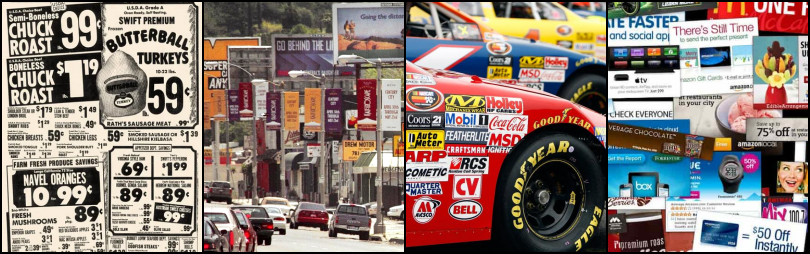
Other than baseball games, I haven’t watched broadcast TV in at least a decade. Well more than twice that since I subscribed to any printed material outlet (such as papers or magazines).
Even movies have ads before they begin (not to mention product placement in the movie itself). We are inundated with the blare of “Buy! Buy! Buy!”
On YouTube, again a free-with-ads business model, the commercial blare has grown from interstitial commercials to commercial interruptions (especially unpleasant when watching a music video) and now most content creators beg for Patreon contributions and promote third-party products. For me it comes close to making YouTube unwatchable.
Each Other (it’s coming from inside the house)
And then there’s the internet. What a lot of noise it brings to our lives.
The conversational part — what’s now called social media — existed almost from the beginning (just ask your grandparents about USENET and email lists). Even internet trolls are old as humanity — they’ve always existed in the form of high school bullies and the like. The maladroit aside, even back then the internet was a little noisy. An old metaphor compares it to a giant park with everyone standing on soapboxes proclaiming their views. As such, the internet was sometimes referred to as a “write-only” medium.
Indeed, that write-only aspect is the source of much of the noise.
Now that our email addresses are increasingly public (one way or another), we’re subject to a barrage of email spam — both from legit sellers and from thieves. In my oldest email account (going back to the 1990s), I get an average of a dozen unasked for — often fraudulent — emails every day. While a lot of it remains laughable, some of the phishing attempts have gotten very sophisticated. (I nearly fell for one a while back — very accurate reproduction of a government site.)
Then came websites. At first new-fangled, but now companies assume everyone has web access. Yet most public websites — social and news sites mainly — are bloated with ads. Not just ads, but animated ads and videos that grab at our eyes and eat our bandwidth.
Beyond that, the interweb is filled with noisy content — all the free opinions in blogs and comments are one thing, but the noise from people guessing at questions asked by others has turned the interweb into a far less valuable resource for answers than it used to be. (See: Tragedy of the Commons)
All the bogus answers, all the misattributed quotes, all the meaningless aspirational and inspirational homilies, all the wishful thinking, pontificating, and virtue signaling … it all adds up to an endless sea of noise.
What one author brilliantly referred to as “the miasma”.
And now there is Ai
Which has the capacity to crank out not streams, not rivers, but a gushing monstrosity of a broken-dam torrent of noise, not one byte nor bit of it meaning anything much.
Just more largely signal-free noise masquerading as content.
What happens as technology and Ai make it ever easier for the sellers and propogandists to hack our brains?
Advertisers already gather large amounts of information about us and use it to tailor their attacks. Remember subliminal images? They didn’t turn out to amount to much, but those early attempts at brain hacking weren’t nothing, either. As technology gets better — as it usually does — advertisers may gain much more of a beachhead in our minds than ever before.
[I think we need to start learning to say “No!” We need to stop eating so many shit-covered raisins because we like the raisin. The enshittification of culture will continue until we put a stop to it, and the only weapon we have is to refuse to engage.]
Some technology — admittedly science fictional for now — has truly terrifying ways of making our opinions and very thought processes malleable.
The Deafening Clamor
This jingle-jangle of distracting keys and sales traps fills too much of our lives. It crowds out history; it crowds out normative literature and art; it crowds out physical reality; it crowds out thought.
Even products and services become noise. Content certainly has. How many streaming services are there now? Broadcast TV, in going digital, increased the noise level by adding channels and then had to fill them with old shows or infomercials (a particularly long-winded kind of noise).
In the end, the sheer volume — in both senses of the word — makes it all meaningless. If familiarity breeds contempt, an abundance of content, sales pitches, opinions, and bad guesses turns it all into meaningless and undistinguishable soup of noise.
We crowd out thought and the lessons of the past with the relentless pointless clammer of now.
No wonder we’re all a bit stunned in the brain.
§ §
And yes, I’m aware of the irony that a post about noise is … more noise.
In fact, full disclosure, this post doubles its noise contribution because it’s a slight rewrite of a Substack post from September of 2005. Since I’m no longer active on Substack (just silently lurking), I’ve decided to repost some of my posts from there here.
Stay quiet, my friends! Go forth and spread beauty and light.
∇







 Logos con carne
March 24th, 2026 at 9:15 am
[…] unfettered greed has become too prominent in how we produce all forms of entertainment (leading to the awful cacophony of advertising). That industrialized take’m-for-everything-fuck-the-art approach has corrupted too much […]
April 7th, 2026 at 9:15 am
[…] to reprise (with minor edits) some of my Substack posts here. I started this last month with The Noise is Deafening, and I’ve got two more somewhat related posts for this […]