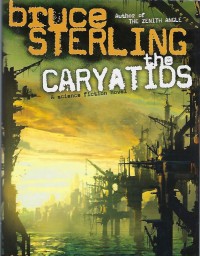
 In yesterday’s post, I wrote about Bruce Sterling, one of the founders of cyberpunk (along with William Gibson). I mentioned being underwhelmed. I enjoyed two of his novels, but the third one, The Caryatids (2009), is among the worst books I’ve read. I skimmed many, many info dump pages in search of a plot.
I make no pretensions of being a fiction writer, and my problems with the book may say more about me than the book. I may well have failed to appreciate some aspect that makes it great.
Regardless, I found it one of the most pointless science fiction novels I’ve read in recent memory. So, this post is a rant to vent my frustration.
Let’s start with what a “caryatid” is. From Wikipedia:
A caryatid is a sculpted female figure serving as an architectural support taking the place of a column or a pillar supporting an entablature on her head.
In the novel, the caryatids are seven (illegal) female clones (plus one male) who were birthed and raised on Mljet, an island in the Adriatic Sea. A revolution that sweeps through the island results in the murder of three of them; the other four escape. The novel is divided into three sections focusing on three. The fourth, “the crazy one”, appears briefly in points throughout the book.
I quote “the crazy one” because she’s referred to that way in the book, but as far as I could tell, they’re all violently bat poop bonkers and not even close to being sympathetic characters. I hated them all.
[Maybe that’s the point, but I have never enjoyed stories about the depths we can sink to. I want stories about the heights we can rise to. This is a big reason I stopped watching Game of Thrones halfway through the second season. I’m as well-acquainted with the foibles of humanity as I care to be.]
The bottom line is that I found The Caryatids ugly, cynical, joyless, negative, and without beauty of any kind. Finishing it was a chore. The only reason I did was to find out if any of the dropped plot lines resolved. In a word: nope.
The plot and character’s behavior actually had me wondering if Sterling was getting senile. He was in his mid-50s when he wrote it, which is young, but my mom has said that (in retrospect) my dad’s Alzheimer’s was apparent around that time.
[Again, I hasten to add that it may be my own lack of ability or ignorance in play here. It’s always possible that I just don’t get it. I often don’t. For whatever it’s worth, I did enjoy Islands in the Net (1988) and more recent The Zenith Angle (2004). Make of that what you will.]
Besides the negative and ugly tone of the book — even the phrasing of the writing wallows in negativity — my other objection is the vast amount of info dumping and internal character rumination. And in many cases, those info dumps and memories sounded like much more interesting stories. I often skimmed multiple pages looking for action or dialog.
[I’m one of those readers — or philistines, if you prefer — who is utterly bored by too much description. Stop telling me stuff and get on with the plot.]
The story seems to me mainly a character study and future vision. But the characters are grotesque and unlikeable (and random and incoherent and violent), so the study had no value for me. Parts of the future vision were a bit interesting, but in nearly all cases, weren’t explored in any detail. Many glossed over ideas would have made a far more interesting story.
§
The first section concerns Vera, who has returned to Mljet to work on recovering it from pollution and the depredations of climate change. She’s part of one of the two competing corporations that have become global powers. The only nation state still remaining is China. Vera and company use advanced computer-powered exoskeletons to do the work “by hand”. Her brother-in-law, John (who she hates), shows up proposing to turn Mljet into a tourist destination. John, and her sister-clone Radmila (who she also hates), belong to the rival corporation.
Vera’s corporation is devoted to “saving the Earth” — think militarized Greenpeace on steroids, a global power. The corporation John and Radmila belong to, based in California, are devoted to making money. Things devolve, clone-brother George (also hated; everyone hates everyone else) shows up, the three escape in a boat, … and that’s the end of the section.
§
The next section follows Radmila who is a “star” in Los Angeles — not a movie star, things have transcended mere movie stardom. There’s more family drama (Radmila hates husband John for unexplained reasons; none of the bitter hatred is really explained, it just is). Radmila is kidnapped by “crazy” clone-sister Biserka (apparently an active criminal and terrorist), but nothing really happens, she’s fine, and the section ends.
There’s talk of the supervolcano discovered beneath Yosemite Valley that seems ready to erupt and destroy life on Earth, but that plot point is ignored (barely mentioned) in the rest of the book. This book drops so many interesting points it never follows up on.
§
The third section follows Sonja, who does medical relief work in China. Sonja is currently in love with a murderous warlord. (Which made as little sense to me as the “love” between Padmé and Anikin.) They visit a Mars simulation, are attacked by some other (poorly defined) group, go after that group, encounter brother-in-law John and another of his brothers.
During this, there is a huge solar flare that damages electronics everywhere and kills the few people in orbit. Including John’s senile mother (former head of the corporation now superseded by Radmila) and the clones bitterly hated criminal mother who is hiding in orbit in her own space station. Everyone involved rejoices about the latter death. And the section ends.
A final bit concerns the funeral for their mother and the meeting of all four remaining clones along with some other people. I was so bored and disengaged by this point that I skimmed it quickly. It’s told from George’s wife’s point of view, a character only referenced briefly until this point. The epilogue is an interview with John and Radmila’s daughter some years later when she’s now the “star”.
§
None of these wrapped up any of the dangling plot threads. It may say something that the Wikipedia entry for the novel is really bare boned. As if no one could be bothered to write about it. Rightly so, I’d say.
Everyone disregards, disrespects, and outright hates everyone else, and most are willing to use violence if they can get away with it. The hatred reaches insensible heights, and everyone is certain they’re right and everyone else is wrong. The book is filled with unsupported and unexplained assertions.
Bottom line, I hated this book and give it an Ugh! — my lowest possible rating.
§
For whatever it’s worth, here are some quotes I pulled to assuage my frustration and give me something to do while being so bored by the book:
“[Took the] secret equipment to the filthy mayhem in Harbin, where that equipment more or less worked. It worked against all sane expectations and it worked radically and it sometimes even worked beautifully.”
Weird writing to my eye. First, it “more or less” worked, but then against expectations and radically and even beautifully. Maybe I’m not appreciating the use of words here, but it’s stuff like this that makes me wonder about Sterling’s mind.
And by the way, there should be a comma after “expectations”.
“Like Zeng himself, this service was in the state, and of the state, and for the state, and yet it was somehow not quite of the state.”
Wait… in and of the state but somehow not quite of the state? Huh?
“Legs shaking, Sonja unsealed the tent and crept out naked and barefoot.”
I suppose one can be naked with shoes on, but that seems more the thing one would mention. Being naked seems to imply being barefoot. (Full disclosure: at this point I was so disgusted with the book that I was looking for offenses.)
This section features some wife beating by the warlord (who insisted Sonja marry him). And Sonja seems basically fine with it. Some other points make me wonder a bit about Sterling’s relationship with and thoughts about women. I almost stopped reading at this point.
“The Acquis and the Dispensation hated China’s state secrecy, for they were obsessed with rogue technologies spinning out of control. Internal combustion: a rogue technology spun out of control. Electric light: a rogue technology spun out of control. Fossil fuel: the flesh of the necromantic dead, risen from its grave, had wrecked the planet.”
The Acquis and the Dispensation are the rival global corporations that have replaced nation states. I think Sterling’s biases are on display calling these “rogue” technologies. Technology is neutral. It’s what we do with them that can be bad (yet I wouldn’t use the word “rogue”).
The Acquis are the eco-freaks, the Dispensation are the money-makers. Both are oriented towards improvement, but the latter want to make money off it.
A minor point, but fossil fuel isn’t from the flesh of anything (common misconception that it’s from dinosaurs). It’s mostly from ancient plants and algae.
“Lionel smiled. ‘Because I have to learn fast! Brilliancy, speed, lightness, and glory!’ It was a sinister business that the Acquis and Dispensation used the same slogan. Why had no one condemned them for that?”
Lionel is John’s brother. The internal thoughts are Sonja’s. The question is an apt one, and one would think it had been pointed out.
“I will not meet John Montalban. Not again, never. I promised that I would never meet him again, or touch him, or look at him.”
Sonja, who had an affair with brother-in-law John (who had affairs with the other three sisters while married to Radmila).
“'[…] would you get over yourself? Just for once? Because my brother is changing the whole Earth out here! It’s not always about you, you, you, and all your clones!’
Sonja regretted that she had not killed Lionel, but there was no help for this.”
Lionel speaking to Sonja. Everyone seems willing to kill anyone else at the mere mention of something they don’t like. Physical attacks are common. The context and dialog seemed very infantile and comic book to me.
“He still loved her. Sonja knew that he still loved her. He really did love her: that was the darkest weapon in his arsenal, and it brought on her a bondage like no other.”
Sonja ruminating about John. Nobody here ever gets over anything. They carry their grudges like cherished possessions. They seem identified by those grudges and hatreds. It seems all they have.
“Inke had been to a host of funerals. She had hated every one of them. Every celebration of death permanently drained Inke of some spark of her own life force.”
Inke is clone-brother George’s wife, widely disdained as “stupid” and “fat assed” by nearly all other characters. Inke herself seems incredibly fragile and, indeed, kind of stupid. While funerals carry the pain of loss, they should be occasions to celebrate the person’s life and rejoice we’re still here to carry on.
I’m not sure if anyone in this book is meant to be an admirable character. I have some sense Sterling means for them to be, or perhaps just Vera and maybe Inke, but I found no value in any of them.
But maybe I’ve badly missed the brilliance of the writing. Could be. All I can say is that I didn’t enjoy it. I may try some of his earlier stuff, but while I’ve liked the two novels I mentioned, and some of the short stories, I found Sterling mostly, in a word, forgettable.
§ §
Stay better than this, my friends! Go forth and spread beauty and light.
∇






 Logos con carne
August 26th, 2025 at 2:52 pm
[…] Can’t put my finger on it; something about his writing (more so Sterling’s — see Sterling: The Caryatids). As a contrasting example, I’ve read some Neal Asher lately and found it thoroughly […]